Would you like to make a retail purchase?
Visit our online store!
Understanding the importance of correct labelling is fundamental and an obligation for any company working with hazardous substances, especially if you operate in the wholesale or private label sector. If you represent a brand that wants to introduce its own line of fragrance products, CLP compliance then you need to be aware that the CLP label is a legal obligation and a sign of credibility and concern for customer welfare.
What is a CLP label?

Let’s start from the beginning. What is the CLP label?
CLP stands for Classification, Labelling and Packaging. The CLP Regulation is the European Union’s legal framework for ensuring that hazardous chemicals and mixtures are:
- clearly identified,
- classified correctly,
- labelled with essential information before they are placed on the market.
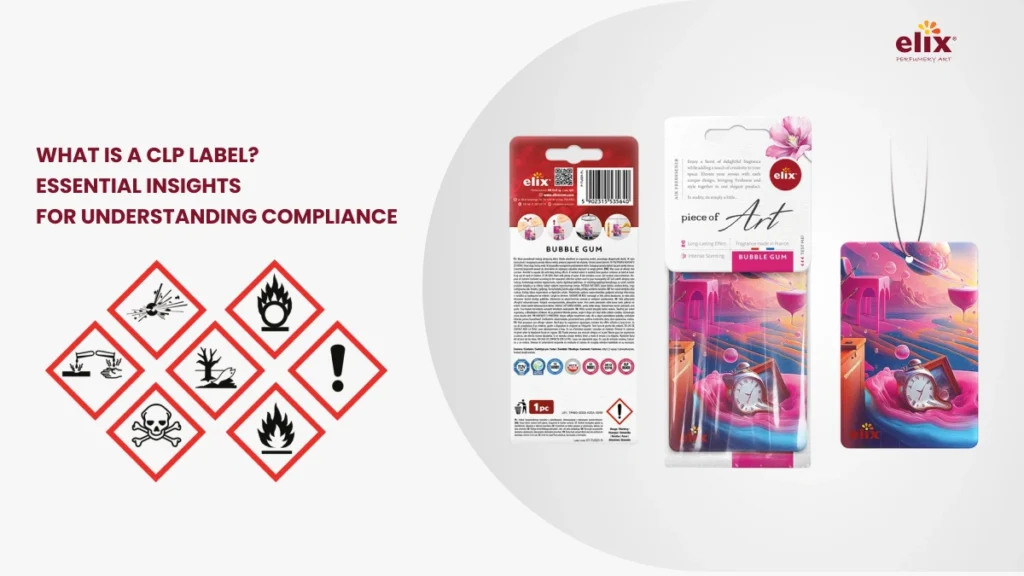
In essence, it is a visible, standardised label that informs users of the potential hazards of a chemical substance or mixture, using a combination of hazard pictograms, signal words, hazard statements, precautionary statements and supplier contact details.

The label must be affixed to the outer packaging of the product and must remain legible and intact throughout the life cycle of the product.
This is a legal requirement for anyone placing chemical products, including candles and melting waxes containing fragrance oils or essential oils, on the EU market.
The label serves as a quick reference for downstream users, providing clear and consistent information on potential hazards and necessary precautions. For businesses, this transparency protects end-users and promotes the free movement of goods across the European Union by harmonising hazard communication standards.
Essential elements of a CLP label – what must be included?
A CLP label it’s a carefully structured document containing essential information.
Each label must include:
- Product identifiers – The name, batch number, and nominal quantity of the chemical substance or mixture.
- Hazard pictograms – Graphical symbols that visually communicate the type of potential hazard (e.g., flammability, toxicity, health hazards).
- Signal words – “Danger” or “Warning”, indicating the severity of the hazard.
- Hazard statements – Standardised phrases describing the nature and degree of the hazard (e.g., “May cause an allergic skin reaction”).
- Precautionary statements – Instructions for safe handling, storage, and disposal (e.g., “Keep out of reach of children”).
- Supplier identification – Name, address, and telephone number of the manufacturer or importer.
- Unique formula identifier (UFI) – A code that links the product to its specific formulation, essential for poison centre notifications.
- Allergen information and supplemental information as required.
- White background for clarity and legibility, as mandated by recent updates to the regulation.[1]
These requirements are not optional. For example, if you are creating your own CLP labels for candles and wax melts, or reed diffusers, every element must be present and formatted according to the latest CLP labelling guidance.
The safety data sheet (SDS) is the foundation for all CLP information, providing detailed information on chemical properties, hazard categories, and necessary precautions.
CLP label example

Who needs a CLP label?
CLP labels are a legal requirement for anyone placing hazardous chemical substances or mixtures on the market within the European Union or the UK. This includes manufacturers, importers, distributors, and brands that commission the production of their own fragrance products, such as air fresheners, reed diffusers, or products containing fragrance oils and essential oils.
If your business introduces a product that contains hazardous substances (whether under your own brand or as a private label) you are responsible for ensuring that every item is correctly classified, labelled, and packaged in accordance with CLP regulations.
You need a CLP label if:
- You manufacture or import chemical substances or mixtures that are classified as hazardous.
- You distribute or sell hazardous chemical products, including fragrance products, air fresheners, and reed diffusers, to consumers or other businesses.
- You commission a professional manufacturer, such as ELiX, to create fragrance products under your brand (each product must have a compliant CLP label before it is placed on the market).
- You repackage or relabel hazardous substances or mixtures, even if you do not alter the formulation.
Remember!
CLP labels are not required for products that are made strictly for personal use and not placed on the market. However, as soon as a product is sold, gifted, or otherwise made available to others, a CLP label becomes mandatory if it contains hazardous ingredients.
The value of certification and professional production – choose wisely and consciously

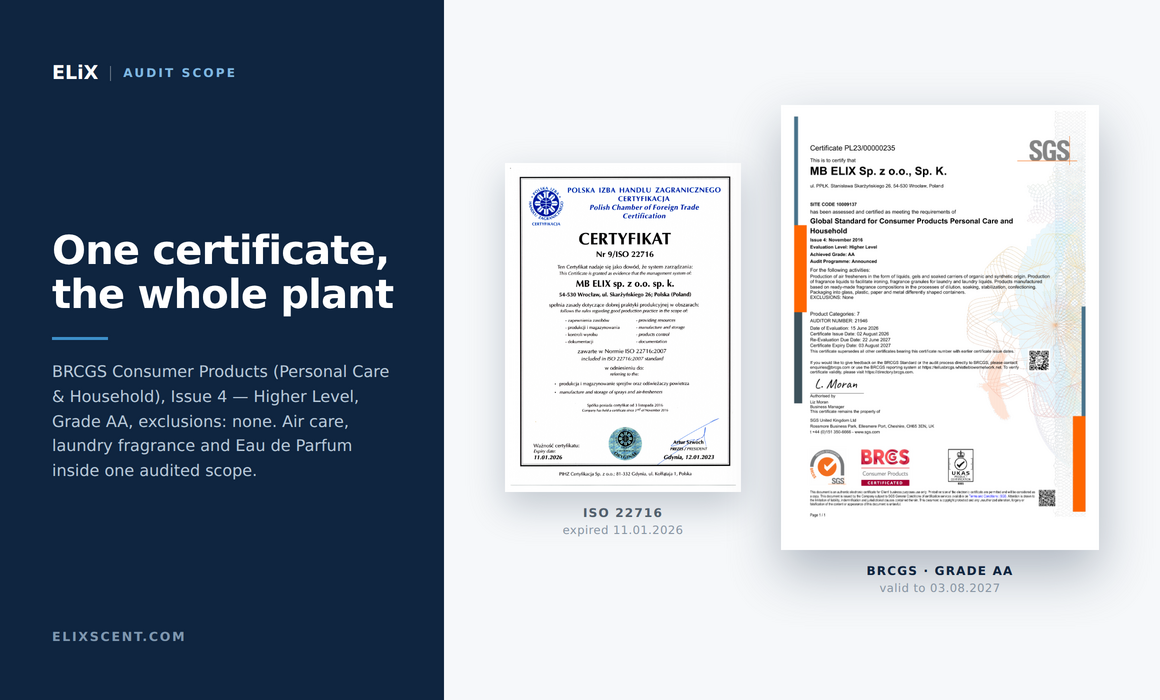
In an industry where potential risks are very possible, working with a professional, certified manufacturer is, quite simply, a must. Certifications such as ISO 9001, ISO 14001 and BRC GS, held by prestigious manufacturers such as ELiX, reassure you that every stage of the production process, from sourcing raw materials to packaging and labelling, is subject to rigorous quality and safety controls.
As certified manufacturers, we have years of experience in navigating complex regulations, so we can provide you with detailed information, compliant labels and up-to-date CLP templates for every product.
This level of professionalism is particularly important for companies looking to enter new markets or offer private label solutions, where the legal and reputational risks of non-compliance can be significant.
By putting compliance first, you protect your customers from potential risks such as allergic reactions or environmental hazards and safeguard your business from costly recalls or fines.
Choose a partner who understands the value of safety, transparency and professionalism at every stage of the process. See our products.
The role of packaging in CLP compliance
Packaging is often an overlooked, yet extremely important aspect of CLP regulations. According to the Classification, labelling and Packaging Regulation:
the packaging of a hazardous substance or mixture must be designed, constructed, and closed in such a way that the contents cannot escape unintentionally at any stage of use.
This means that packaging materials must be robust, durable, and resistant to damage caused by the product itself. Reclosable closures, such as caps or lids, must allow repeated opening and closing without the risk of leakage or spillage.
Remember, it is not enough for the packaging to simply look professional. Above all, it must provide a high level of safety during:
- transport,
- storage,
- everyday (often intensive) use.
Additionally, when hazardous substances are offered to consumers, the packaging must not attract the attention of children or mislead consumers by resembling food, animal feed, or cosmetics. This is a legal requirement aimed at preventing accidental exposure, especially among the most vulnerable.
For certain products, child-resistant closures and tactile warnings are also required, depending on the hazard class. For example, products containing methanol or dichloromethane above specified thresholds must be fitted with child-resistant closures. Packaging that does not meet these requirements exposes the manufacturer to legal sanctions, loss of customer trust, and a threat to public health.
Why CLP labels are important – protecting health, business and brand
As we have highlighted on several occasions, the importance of CLP labels goes far beyond regulatory compliance. The correct classification, labelling and packaging of hazardous chemicals is of indisputable and fundamental importance for the protection of human health and the environment.
By clearly displaying hazard classes and categories, CLP labels enable users to make informed decisions and take necessary precautions when handling, storing or disposing of products containing hazardous substances.
For companies in the perfume industry, CLP labels are also an important part of responsible branding. They demonstrate a commitment to safety, transparency and quality. This approach and full commitment is particularly important in sectors where allergic reactions or environmental risks are a concern. Inaccurate or incomplete labels can lead to legal penalties, product recalls or image damage, which can be avoided by following CLP labelling guidelines and using compliant CLP label templates.
In recent years, CLP compliance rates in the EU have ranged from 73% to 97%, with an average of 75% in 2015-2019. These figures show the importance of vigilance and continuous improvement in hazard communication.[2]
In the case of private labels and contract manufacturing, such as the services offered by our ELiX manufactory, ensuring that each product bears the correct CLP label is a sign of professionalism and reliability.
Recent changes and compliance deadlines – what’s new in CLP regulations?
With the publication of the updated EU Classification, Labelling and Packaging of hazardous chemicals Regulation in November 2024, there are several new provisions that businesses must be aware of:
- Mandatory formatting rules for labels, including minimum font sizes, spacing, and use of black text on a white background for new products from November 2026.
- Enhanced requirements for digital labelling and fold-out labels or leaflets, particularly for products with limited space.
- Requirement for EU-based supplier contact details on every label.
- New hazard classes, including rules for endocrine disruptors and updated classification change procedures.
- Stricter requirements for online marketplaces and distance sales, ensuring that all CLP label elements are visible to consumers before purchase.
These changes affect all actors in the supply chain, from manufacturers and importers to downstream users and retailers. Non-compliance is not only a legal risk but can also disrupt business operations, especially for brands seeking to expand across the European Union or into the UK, where both EU CLP and GB CLP rules may apply.
Be sure to read one of our top articles: Understanding air freshener safety and ingredients | ELiX Scent
Labelling and Packaging – practical guidance for Your brand
If you commission the production and labelling of fragrance products from a professional manufacturer, you naturally do not need to know all the technical details of CLP. However, in our opinion, it is worth knowing what to pay attention to so that your brand is safe and compliant with the regulations.
The most important issue is that every product bearing your brand’s logo should have a label prepared in accordance with the current CLP guidelines. It should include all the required elements: hazard pictograms, signal words, hazard statements, precautionary statements, product identifiers and the manufacturer’s contact details.
At ELiX, we always remind our clients that a good label is not a wall of text. A well-designed, professional label should be clear, legible and permanently affixed to the packaging. By working with an experienced manufacturer such as ELiX, you can be sure that the labels will be resistant to abrasion, moisture and contact with chemicals throughout the product’s entire period of use.
The packaging itself should also be robust, tight and suited to the type of product, in order to prevent accidental release of the contents.
A professional manufacturer will also take care of complete documentation – safety data sheets, batch numbers and compliance with the latest regulations. Thanks to this, you can focus on building your brand and relationships with your clients, safe in the knowledge that your product is secure, legal and ready for the European market.
CLP label design and compliance at ELiX
We understand that creating compliant CLP labels for fragrance products and air fresheners can be complex, especially for brands introducing their own lines to the market. That is why we have developed a comprehensive, streamlined process for designing and producing CLP labels that meet all regulatory requirements.
Our approach allows you to provide us with the essential product details, such as fragrance composition, batch numbers, and intended use. We then prepare tailored CLP labels using up-to-date templates, ensuring that every label includes all mandatory elements:
- hazard pictograms,
- signal words,
- hazard and precautionary statements,
- product identifiers,
- full contact details.
We also generate and include the Unique Formula Identifier (UFI) where required, supporting full traceability and compliance.
By entrusting ELiX with your labelling needs, you can be confident that each product will be labelled clearly and professionally, in accordance with the latest CLP regulations. Our team ensures that every label is resistant to abrasion, moisture, and chemical exposure, remaining legible and intact throughout the product’s lifecycle.
We also offer support for multi-language labelling, so your products are ready for distribution across the European Union.
With ELiX, you can focus on building your brand, knowing that your fragrance products and air fresheners are safe, compliant, and ready for the European market.
source:
[1] Updated EU Chemicals, Labelling and Packaging (CLP) Regulation: implications for labels, advertisers, online marketplaces; link to page:Updated EU Chemicals, Labelling and Packaging (CLP) Regulation: implic
[2] CLP controls: percentage of compliant cases found in Member States (Indicator); link to page:Updated EU Chemicals, Labelling and Packaging (CLP) Regulation: implic