Short answer: since 31 July 2026, cosmetic products newly placed on the EU market, including Eau de Parfum and body mists, must name 81 fragrance allergen entries on the label (often quoted as “80+”). The original list had 26 substances, and 24 of them were still named after two bans. Laundry perfumes and air fresheners follow different rules: the Detergents Regulation and CLP.
What do you need to know? Go straight to your answer:
Also: All dates · Search the full allergen list · FAQ
Need allergen documentation for a product or market? ELiX provides SDS, CLP labels, UFI, IFRA certificates and allergen information for private label projects.
Contact ELiXWhich allergen rule applies to your product?
| Product | Regulation | How allergens appear on the label | Key dates |
|---|---|---|---|
| Eau de Parfum, body and hair mist | Cosmetics Regulation 1223/2009, amended by 2023/1545 | Named individually in the ingredient list above 0.001% (leave-on) | 31.07.2026 for new placings; old labels sellable until 31.07.2028 |
| Laundry perfume, scent booster, fabric softener | Detergents Regulation 648/2004, from 23.09.2029 Regulation 2026/405; CLP also applies | Allergenic fragrances above 0.01% named on the label; CLP sensitiser labelling (H317 / EUH208) where applicable | 23.09.2029; microplastics 17.10.2028 (detergents) and 17.10.2029 (fragrance capsules) |
| Home and car air fresheners, reed diffusers, room sprays, diffusion oils | CLP Regulation 1272/2008 | Sensitisers shown as H317 with pictogram, or the EUH208 sentence “Contains (name). May produce an allergic reaction.” | Revised CLP format 01.01.2028 (possible deferral pending) |
Key dates 2026–2030
- Cosmetics Expanded allergen list required for cosmetics newly placed on the EU market (Regulation (EU) 2023/1545).
- Air careLaundry Revised CLP label format and online-sales rules apply (Regulation (EU) 2025/2439).
- Cosmetics Last day on which cosmetics with old labels may be sold.
- LaundryAir care Microplastics restriction for detergents and air care products (Regulation (EU) 2023/2055).
- Laundry New Detergents Regulation (EU) 2026/405 applies.
- Laundry Microplastics restriction for encapsulated fragrances.
- Air careLaundry Possible new date for most amended CLP provisions, if the simplification package is formally adopted.
For perfume and cosmetics brands
What changed for perfumes and cosmetics in 2026?
Why do sources say 80, 81 or 82 allergens?
The original EU list had 26 fragrance allergens. Two of them, HICC (Lyral) and Lilial, were later banned, so 24 were named on labels until July 2026. Regulation (EU) 2023/1545 made three changes:
- It added 45 new entries to Annex III (entries 327–371). Several of them group related substances or essential oils.
- It introduced a labelling requirement for 12 existing restricted substances, such as Turpentine, Rose Ketones and Methyl Salicylate.
- It rewrote 17 existing entries to align names and add isomers.
That gives 81 entries (24 + 12 + 45). The EU Scientific Committee on Consumer Safety counted 56 new allergens, which is why sources quote 80, 81 or 82. All three figures describe the same list.
How do the labelling rules work?
- The threshold applies to the finished product. Example: a fragrance oil containing 0.01% of an allergen, dosed at 15% in an Eau de Parfum, gives 0.0015% in the product. That is above 0.001%, so the allergen must be named.
- Amounts from different sources add up. The same allergen coming from several raw materials is counted together.
- The regulation prescribes the label names. For grouped entries it sets the name to use, for example “Citrus Aurantium Peel Oil” for bitter and sweet orange peel oils, or “Lemongrass Oil” for the Cymbopogon oils.
- Cosmetics cannot use digital-only labelling. Allergens must be printed on the pack.
How are essential oils declared?
Essential oils on the list are named in their own right, and the allergens they contain are named as well. If lavender oil exceeds the threshold, “Lavandula Oil/Extract” must be named, and so must Linalool if its share from that oil also exceeds the threshold. This example comes from the Austrian authority AGES.
Which common fragrance notes are now named?
| Note family | New label names |
|---|---|
| Vanilla, gourmand | Vanillin |
| Lavender | Lavandula Oil/Extract, Linalyl Acetate |
| Citrus | Citrus Limon Peel Oil, Citrus Aurantium Peel Oil, Citrus Aurantium Bergamia Peel Oil, Lemongrass Oil |
| Mint | Menthol, Mentha Piperita Oil, Mentha Viridis Leaf Oil, Camphor |
| Floral | Rose Flower Oil/Extract, Jasmine Oil/Extract, Cananga Odorata Oil/Extract, Geranyl Acetate, Pelargonium Graveolens oils |
| Woody | Santalum Album Oil, Santalol, Acetyl Cedrene, Tetramethyl Acetyloctahydronaphthalenes |
| Musk | Hexamethylindanopyran, Hexadecanolactone |
| Spicy | Eugenia Caryophyllus Oil, Cinnamomum Zeylanicum Bark Oil, Eugenyl Acetate |
| Earthy, resinous | Pogostemon Cablin Oil, Pinene, Sclareol |
“Natural” does not mean “allergen-free”: a perfume rich in bergamot, lavender or rose oil often has a longer allergen list than a synthetic composition.
Example: one perfume label, before and after
Illustrative example, not an ELiX product. Bergamot oil is now named, and the Limonene and Linalool it contains stay on the list.
For laundry perfume brands and retailers
Do the new allergen rules apply to laundry perfumes?
Today (Regulation 648/2004): allergenic fragrances above 0.01% by weight must be named on detergent labels. Interpretations differ on whether the expanded cosmetics list already applies to detergents, so ask your supplier for a declaration that covers the full list.
From 23 September 2029 (Regulation (EU) 2026/405):
- Laundry perfumes are in scope. The definition of a detergent explicitly covers products intended “to modify the feel or odour of fabrics” (Article 2(1)), which includes laundry perfumes and scent boosters.
- Allergens stay on the physical label. Allergen disclosure is aligned with the Cosmetics Regulation. More detailed composition data may move to a digital label (QR code).
- No double mention. Where CLP already requires an allergen to be named, the detergent rule does not add a second mention (Recital 32).
- Existing stock can be sold. Products placed on the market under the old rules before the application date may stay on sale. Products placed under the old rules in the following year may be sold until 23 September 2030.
Laundry perfumes are also CLP mixtures, so the H317 and EUH208 rules described for air fresheners apply to them too. See the EUH208 wording in EN, DE, FR, ES and PL.
Microplastics: under Regulation (EU) 2023/2055, synthetic polymer microparticles are restricted in detergents from 17 October 2028 and in fragrance encapsulation from 17 October 2029. For scent boosters, one relaunch that covers both regulations is more efficient than two. See also how retailers can prepare for the microplastics ban and OEM laundry perfumes.
Planning a laundry perfume range for 2029? Ask for allergen documentation for your SKUs →
For air care and home fragrance
How are allergens labelled on air fresheners and diffusers?
Air fresheners, car fresheners, reed diffusers, room sprays and diffusion oils are neither cosmetics nor detergents. The cosmetics allergen list does not apply to them; CLP does. The general limits are:
| Sensitiser category | H317 + pictogram from | EUH208 sentence from |
|---|---|---|
| Skin Sens. 1 / 1B | 1% | 0.1% |
| Skin Sens. 1A | 0.1% | 0.01% |
Some substances have their own specific concentration limits, which then apply instead of the general ones. Source: ECHA, Complying with CLP when making or importing candles.
EUH208 wording in ELiX’s main market languages
Translating CLP labels into other EU languages
ValidLabels translates CLP label text into all 24 official EU languages. Standard hazard (H) and precautionary (P) statements are taken directly from the official EU texts of the CLP Regulation, and every translation is versioned. Product-specific text is AI-assisted, so check it before printing. Classification, the EUH208 sentence and the UFI come from your supplier’s SDS. EU languages only; GB CLP is not covered.
ValidLabels is developed by Awakast P.S.A., ELiX’s technology partner.
Or have ELiX prepare the CLP labels for your private label SKUs: contact us →
What changes next under CLP?
- 1 January 2028: the revised CLP label formatting and online-sales rules apply (Regulation (EU) 2025/2439 moved them from 2026).
- Pending: a further simplification package was agreed on 17 June 2026 and approved by the European Parliament on 22 October 2026, but the Council has not yet formally adopted it. Reports of the agreement indicate that most amended CLP provisions would then apply from 1 January 2030.
- Minimum text size: the package sets an x-height of at least 1.2 mm for products sold to consumers, or 0.9 mm for packs of 125 ml or less (European Parliament).
- Until the package is published, 1 January 2028 remains the legal date.
- 17 October 2028: air care products containing synthetic polymer microparticles become restricted.
More on CLP: What is a CLP label? · Managing CLP multilingual labelling
For all product types
Which documents should you request for each product (SKU)?
- An allergen declaration for the fragrance oil covering the full 2023/1545 list
- A calculation of each allergen at the finished-product dose
- The IFRA certificate
- The SDS and, for air care and detergents, the CLP label and UFI
- For detergents: the ingredient datasheet
- For cosmetics: confirmation that the product information file and the CPNP notification are updated, plus the new label artwork
For private label projects: request this document set for your SKUs →
For distributors and retailers
What must distributors and retailers check?
- Distributor duty: under Article 6 of the Cosmetics Regulation, distributors must check that labelling and language requirements are met before making a product available.
- The date applies per unit: “placed on the market” refers to each individual unit. Keep the delivery notes or invoices that show when your stock was first supplied in the EU.
- Relabelling risk: a distributor who modifies a product in a way that may affect compliance becomes its Responsible Person (Article 4(6)). Translating the label alone does not count as such a modification.
- Old stock: by 31 July 2028, cosmetics with old labels must be sold, relabelled by the Responsible Person or withdrawn.
- Languages: allergen names are INCI names and stay the same in every language. The rest of the label follows each country’s language rules, for example French in France and Spanish in Spain. For CLP products (air care, detergents), see the overview of CLP label language requirements by country (ValidLabels).
See also: documents to request for each product.
For UK buyers
Does the UK require the expanded allergen list?
| Market | Cosmetics allergen list | Air fresheners, diffusers, detergents (CLP) |
|---|---|---|
| EU 27 | Expanded list (2023/1545), required for new placings since 31.07.2026 | EU CLP; UFI required for hazardous mixtures |
| Northern Ireland | Expanded list: the EU Cosmetics Regulation applies under the Windsor Framework | EU CLP, including UFI |
| Great Britain | Original list: the expansion had not been adopted at the time of writing | GB CLP with a GB supplier address; no UFI |
Naming the additional allergens is lawful in Great Britain, so the EU ingredient list can also be used there. The rest of the label still needs GB details: a UK Responsible Person for cosmetics and a GB supplier address for CLP products. Check the current position with OPSS and the CTPA.
How does ELiX support compliance?
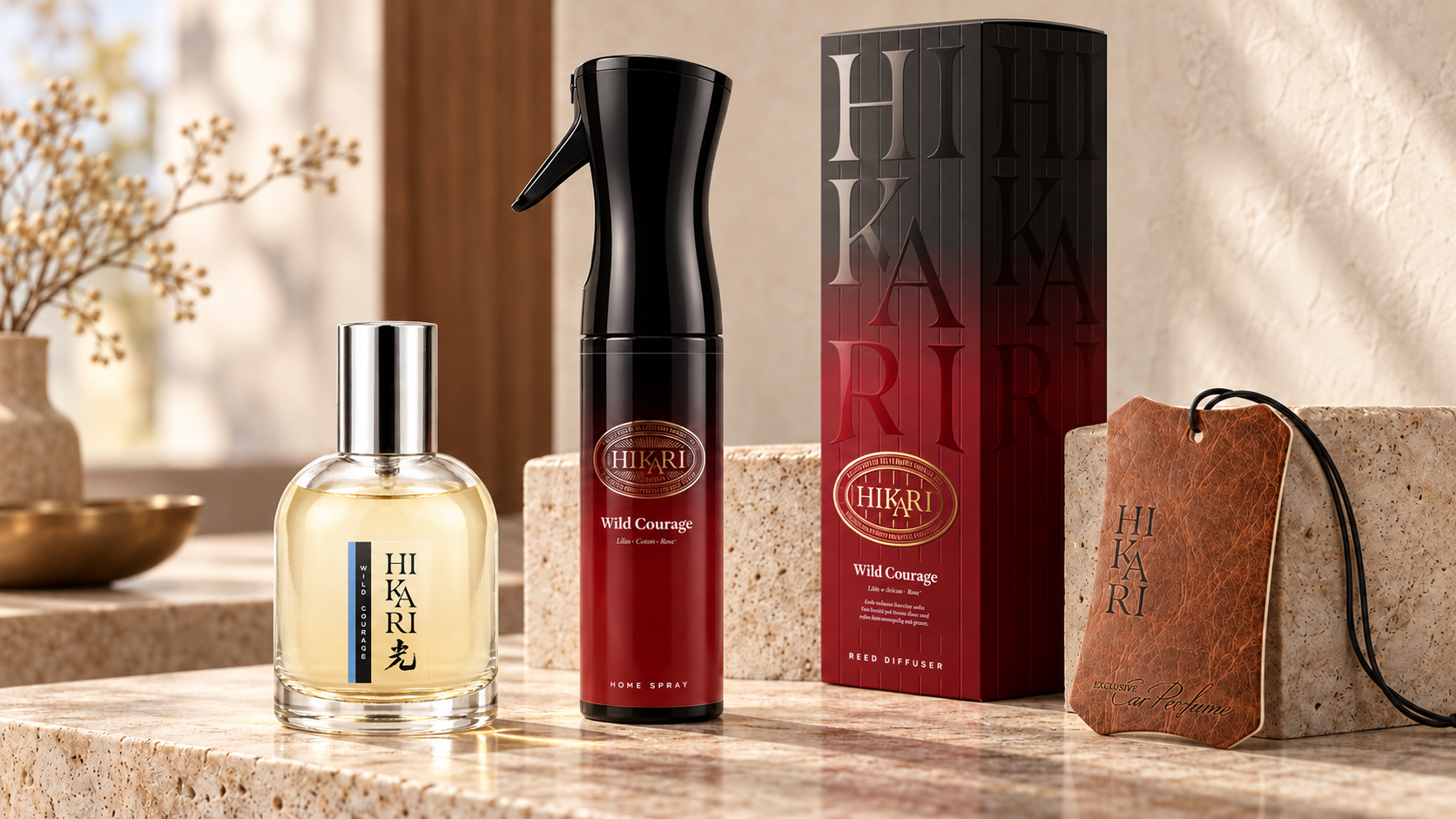
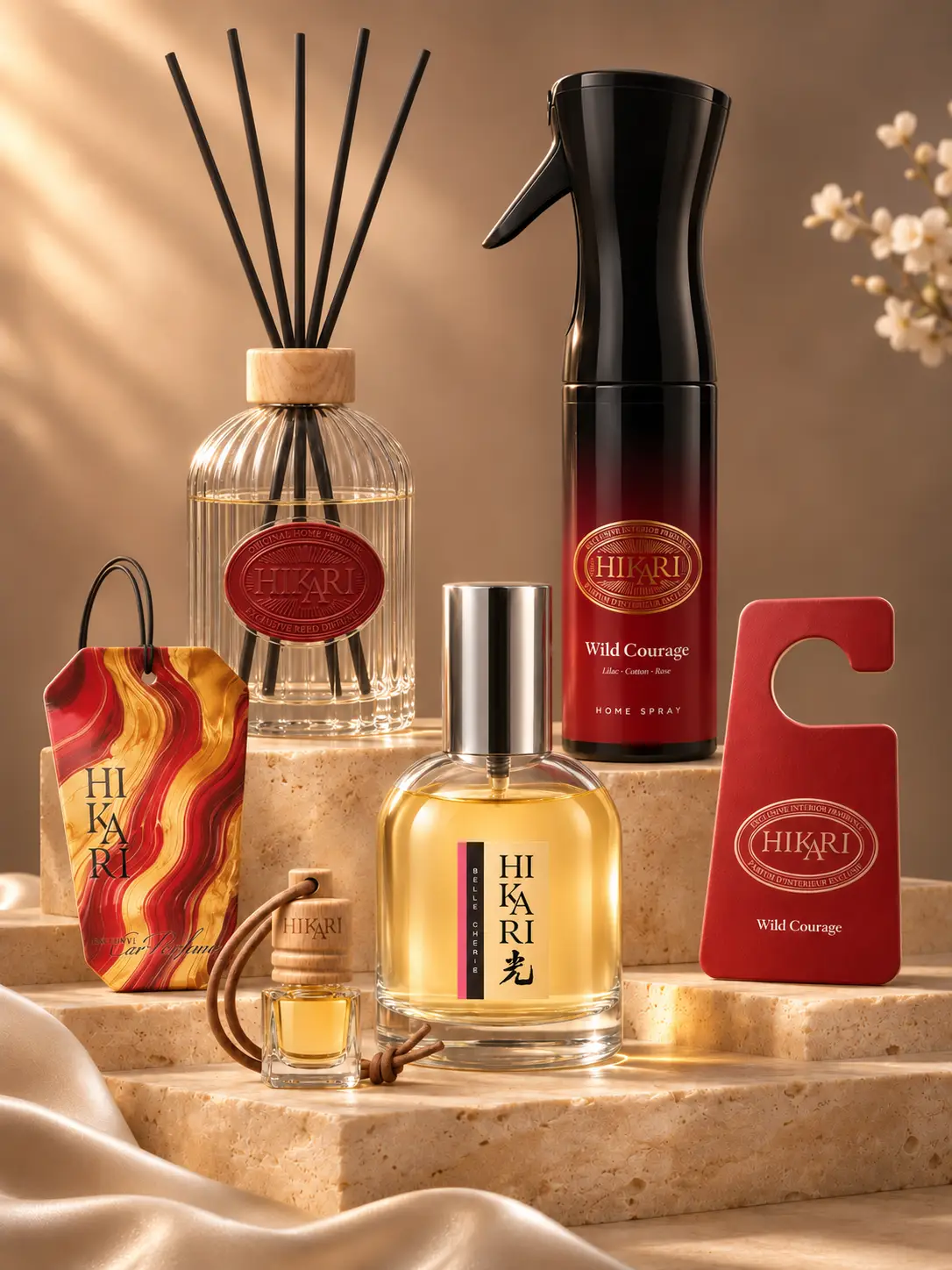
- The labels of our own brands, HIKARI and Amarella, already follow the current requirements.
- For private label projects, we provide SDS, CLP labels, UFI, IFRA certificates and allergen information in your market languages.
- Production is certified to BRCGS Consumer Products and ISO 22716 (cosmetics GMP).
Full list: which 81 fragrance allergens must be named?
Label names as set by Regulation (EU) 2023/1545. For CAS and EC numbers, see the Regulation.
Not found among the 81 entries. Check the spelling or the INCI name.
Original 24 allergens, named since 2005
- Alpha-Isomethyl Ionone
- Amyl Cinnamal
- Amylcinnamyl Alcohol
- Anise Alcohol
- Benzyl Alcohol
- Benzyl Benzoate
- Benzyl Cinnamate
- Benzyl Salicylate
- Cinnamal
- Cinnamyl Alcohol
- Citral
- Citronellol
- Coumarin
- Eugenol
- Evernia Furfuracea Extract
- Evernia Prunastri Extract
- Farnesol
- Geraniol
- Hexyl Cinnamal
- Hydroxycitronellal
- Isoeugenol
- Limonene
- Linalool
- Methyl 2-Octynoate
12 restricted substances, now also named
- 6-Methyl Coumarin
- Pinus Mugo
- Pinus Pumila
- Cedrus Atlantica Oil/Extract
- Turpentine
- Alpha-Terpinene
- Terpinolene
- Myroxylon Pereirae Oil/Extract
- Rose Ketones
- 3-Propylidenephthalide
- Lippia Citriodora Absolute
- Methyl Salicylate
45 new entries (Annex III, entries 327–371)
- Acetyl Cedrene
- Amyl Salicylate
- Anethole
- Benzaldehyde
- Camphor
- Beta-Caryophyllene
- Carvone
- Dimethyl Phenethyl Acetate
- Hexadecanolactone
- Hexamethylindanopyran
- Linalyl Acetate
- Menthol
- Trimethylcyclopentenyl Methylisopentenol
- Salicylaldehyde
- Santalol
- Sclareol
- Terpineol
- Tetramethyl Acetyloctahydronaphthalenes
- Trimethylbenzenepropanol
- Vanillin
- Cananga Odorata Oil/Extract
- Cinnamomum Cassia Leaf Oil
- Cinnamomum Zeylanicum Bark Oil
- Citrus Aurantium Flower Oil
- Citrus Aurantium Peel Oil
- Citrus Aurantium Bergamia Peel Oil
- Citrus Limon Peel Oil
- Lemongrass Oil
- Eucalyptus Globulus Oil
- Eugenia Caryophyllus Oil
- Jasmine Oil/Extract
- Juniperus Virginiana Oil
- Laurus Nobilis Leaf Oil
- Lavandula Oil/Extract
- Mentha Piperita Oil
- Mentha Viridis Leaf Oil
- Narcissus Extract
- Pelargonium Graveolens Flower Oil
- Pogostemon Cablin Oil
- Rose Flower Oil/Extract
- Santalum Album Oil
- Eugenyl Acetate
- Geranyl Acetate
- Isoeugenyl Acetate
- Pinene
A corrigendum published in November 2025 extended entries 364 and 365 to further oil names (Pelargonium Graveolens Oil and Leaf Oil, Pogostemon Cablin Leaf Oil) and corrected a Rose Ketones name.
FAQ
How many fragrance allergens must be labelled in the EU in 2026?
81 entries in Annex III of the Cosmetics Regulation: the original 24, 12 restricted substances newly subject to labelling and 45 new entries. Sources quote 80 to 82 depending on how grouped entries are counted.
When do the new allergen labels apply?
From 31 July 2026 for cosmetics newly placed on the EU market. Products placed on the market earlier may be sold until 31 July 2028.
What are the thresholds?
0.001% in leave-on products and 0.01% in rinse-off products, measured in the finished product.
Do essential oils have to be declared separately?
Yes. Listed oils such as lavender or bergamot are named in their own right. The allergens they contain, such as Linalool or Limonene, are also named if they exceed the threshold.
Do the new rules apply to laundry perfumes?
Laundry perfumes are detergents, not cosmetics. Allergenic fragrances above 0.01% must already be named today. From 23 September 2029, the new Detergents Regulation (EU) 2026/405 aligns allergen disclosure with the Cosmetics Regulation.
Do air fresheners and reed diffusers need an allergen list?
They do not need a cosmetics-style list. They follow CLP: sensitisers are shown through H317 or the EUH208 sentence “Contains (name). May produce an allergic reaction.”
Does the UK require the new allergens?
Great Britain had not adopted the expanded list at the time of writing. Northern Ireland follows the EU rules.
Sources
- Commission Regulation (EU) 2023/1545, fragrance allergen labelling (EUR-Lex)
- Regulation (EU) 2026/405 on detergents and surfactants (Official Journal)
- Commission Regulation (EU) 2023/2055, synthetic polymer microparticles (EUR-Lex)
- European Parliament, 17 June 2026: chemicals simplification deal
- Bens Consulting: European Parliament approves CLP simplification, 22 October 2026
- ECHA: Complying with CLP when making or importing candles
- AGES: New fragrance regulation in cosmetics
- CTPA: UK cosmetic regulations
- EU & UK fragrance allergen rules (GB status)