Certification · Audit scope
BRCGS Consumer Products (Personal Care & Household) vs ISO 22716: Why We Replaced One Certificate With the Other
On 11 January 2026 our ISO 22716 certificate expired and we did not renew it. The reason is one structural difference that almost no supplier explains to buyers: a GMP certificate can cover a chosen part of a factory, while a BRCGS Consumer Products certificate has to cover all of it.
The short answer
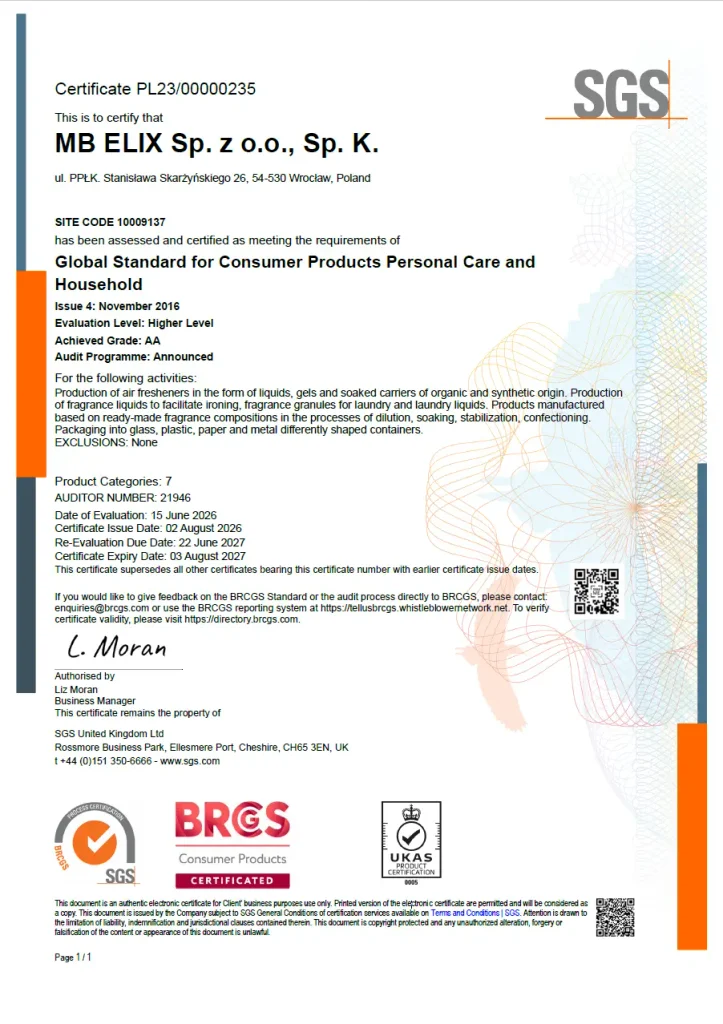
We hold BRCGS Consumer Products (Personal Care & Household), Issue 4 — certificate PL23/00000235, issued by SGS United Kingdom Ltd, Higher Level, Grade AA, audited 15 June 2026, exclusions: none.
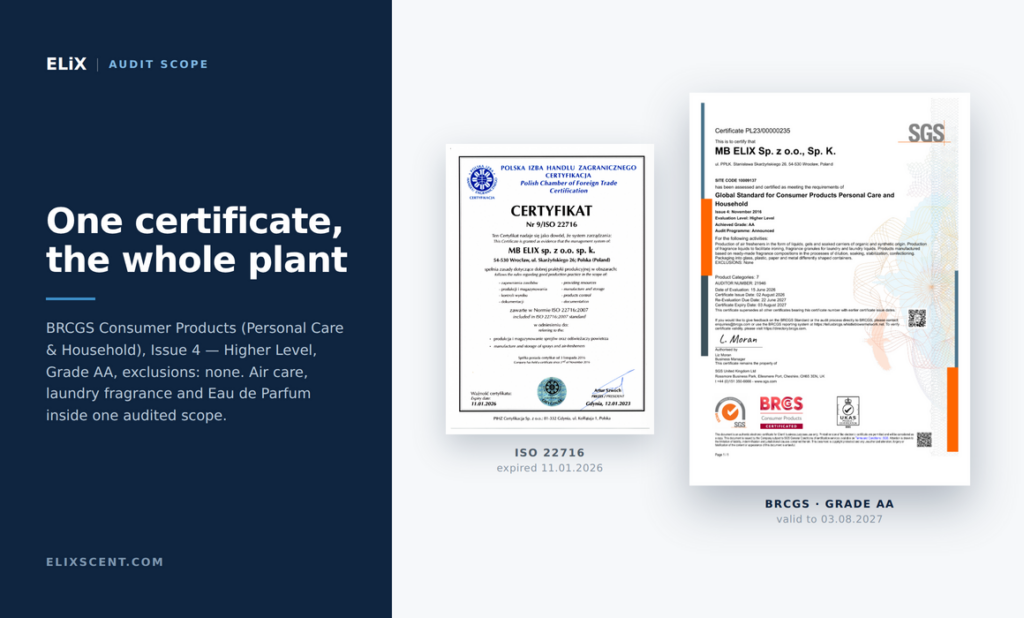
Our ISO 22716 certificate covered “manufacture and storage of sprays and air-fresheners”. That is all it covered. It never described the laundry programme — gels, conditioners, fragrance granules — which is now a substantial share of our private label output.
We did not stop working to cosmetic GMP; that obligation is unchanged. We stopped paying for a second attestation that covered part of the plant, was not gradeable, and could not be verified by anyone except us.
The two scopes, side by side
A certificate is worth exactly what its scope statement says, and buyers almost never read it. Here are ours, verbatim.
| ISO 22716:2007 (Cosmetics GMP) cert. 9/ISO 22716, PIHZ Certyfikacja |
BRCGS Consumer Products (Personal Care & Household), Issue 4 cert. PL23/00000235, SGS United Kingdom Ltd |
|
|---|---|---|
| Scope | “manufacture and storage of sprays and air-fresheners” | Air fresheners as liquids, gels and soaked carriers; fragrance liquids for ironing; fragrance granules and laundry liquids; products made from ready-made fragrance compositions by dilution, soaking, stabilization, confectioning; packing into glass, plastic, paper and metal containers |
| Exclusions | not stated | None |
| Result | pass, no grade | Higher Level, Grade AA, announced audit |
| Site & auditor ID | none on the certificate | site code 10009137, auditor 21946, UKAS mark 0005 |
| Independent verification | no public register | directory.brcgs.com |
| Status | expired 11 January 2026 | valid to 3 August 2027, re-audit due 22 June 2027 |
Both certificates are issued to MB ELiX sp. z o.o. sp.k., ul. Skarżyńskiego 26, 54-530 Wrocław, Poland.
GMP certifies a part of production. BRCGS certifies the whole plant.
This is the difference that matters, and it is the reason we made the change. Under ISO 22716 the manufacturer and the certification body agree a scope line between themselves. Under BRCGS the scope is dictated by the protocol.
An ISO 22716 scope can be one product family. It can be one production hall. Nothing in the standard obliges that line to describe everything the site makes, and nothing on the certificate tells the reader what was left outside it. Ours said sprays and air fresheners, and it was accurate — it simply described a fraction of what we produce.
BRCGS works the opposite way. As the independent certification guidance states: “The scope of your audit must include all of the products you produce, the production method(s) and packaging format(s).” Anything omitted must be printed on the certificate as an exclusion, must be explainable in a single line, and must be physically segregated from what is inside. Shared areas are always in scope.
“Production of air fresheners in the form of liquids, gels and soaked carriers of organic and synthetic origin. Production of fragrance liquids to facilitate ironing, fragrance granules for laundry and laundry liquids. Products manufactured based on ready-made fragrance compositions in the processes of dilution, soaking, stabilization, confectioning. Packaging into glass, plastic, paper and metal differently shaped containers.
EXCLUSIONS: None“
So when you compare two suppliers and one shows GMP while the other shows BRCGS, you are not comparing two grades of the same assurance. You are comparing a chosen sentence with a whole factory.
- Scope
- The written statement of what was audited. It is transferred verbatim onto the certificate. Read it before you read anything else.
- Exclusion
- A product or process deliberately left outside the audit. Under BRCGS it must appear on the certificate. Under a GMP certificate it usually appears nowhere.
- Evaluation level
- BRCGS Consumer Products offers a foundation level, which is pass or fail, and a higher level, audited against the full requirement set and graded AA to D.
- Grade
- The audit outcome, printed on the certificate and published in the directory. AA is the top grade on the announced programme; unannounced audits carry a “+”.
What BRCGS is built on
BRCGS is not an industry self-assessment. The British Retail Consortium — the trade body of UK retailers — published its first standard in 1996, and the first edition of the Food Technical Standard in 1998, because retailers were sending their own auditors into the same factories repeatedly and needed one defensible basis for due diligence over own-brand goods. The standard was written by the buyers, for the buyers. The Consumer Products standard followed in 2003, and the scheme was sold to the LGC Group in 2016, so it now operates independently of the retailers who created it.
The engineering underneath it is HACCP. BRCGS describes its founding principle as the “systematic identification of hazards, the understanding of controls necessary to eliminate or reduce the hazard to an acceptable level and the implementation of control measures in the manufacturing process.” In the Consumer Products standard that appears as product risk management: a documented risk assessment establishing that a product’s design is safe and legal before production starts, followed by audited management commitment, site standards, process control, product inspection and testing, and personnel.
That discipline is now commercially useful as well as technical. Since 13 December 2024 the EU General Product Safety Regulation (EU) 2023/988 has required manufacturers to run an internal risk analysis and hold technical documentation — evidence that buyers’ compliance teams ask for routinely.
Who trusts BRCGS — and what people outside the scheme say
We would rather quote sources with no interest in our certificate than praise it ourselves.
Trade press. Cosmetics Business, on BRC audits in the cosmetics sector: “In cosmetics, they are regarded as the highest level of manufacturing standards after Pharmaceutical production.”
Another manufacturer’s buying guide. Cosmewax, a Spanish cosmetics contract manufacturer, tells brands that BRCGS is “essential to ensure the safety, integrity, legality and quality of products, especially for those supplying retailers.”
Independent research. Birkbeck, University of London, in The Economic Impact for Manufacturing Sites Operating to BRCGS Certification, reports 55% of respondents seeing increased sales after certification, 28% higher profitability and 70% reporting efficiencies from the required production changes. It was commissioned by the scheme owner and is weighted towards food sites, so read it as directional rather than as proof — but it is the only structured dataset on the question.
Three facts about the scheme itself carry more weight than any endorsement:
- It is deliberately hard to hold. There are just over 700 BRCGS Consumer Products certificated sites in 48 countries, growing around 11% year on year. Across the scheme, BRCGS reports over 15,500 non-conformities identified and corrected — the value is in what the audit forces to change, not in what it declares already perfect.
- The record is not ours to edit. The BRCGS Directory holds more than 28,000 audits across 100+ countries, fed by over 90 certification bodies. Reports are read-only PDFs; site owners cannot amend or delete their own records. You never have to rely on a PDF we selected and sent you.
- The audit has consequences. Non-conformities must be evidenced within 21 calendar days of the audit and closed within 28, or no certificate issues. Our certificate carries the UKAS Product Certification mark 0005, site code 10009137 and auditor registration 21946 — every one of them checkable without us.
Does the BRCGS certificate cover body perfume?
1. The scope rule. A BRCGS scope must cover everything the site produces, and anything excluded must be printed on the certificate. Ours says EXCLUSIONS: None. Our Eau de Parfum is made at Skarżyńskiego 26, so it sits inside the audited scope by the construction of the scheme, not by our reading of it.
2. The scope wording. “Products manufactured based on ready-made fragrance compositions in the processes of dilution, soaking, stabilization, confectioning. Packaging into glass, plastic, paper and metal differently shaped containers.” That is a description of processes, not a list of product names — and it describes exactly how an Eau de Parfum is made: a ready-made composition diluted in cosmetic-grade ethanol, stabilised, confectioned, filled into glass. The same sentence covers a gel air freshener and a laundry granule because it is the same certified process control, in the same plant, in the same audit.
And the standard is Personal Care and Household. BRCGS positions it for formulated products with higher hygiene requirements, cosmetics among them. Personal care is not a category we are borrowing; it is half the title of the standard we hold.
What the certificate does not do is print the words “Eau de Parfum”. If your compliance team works from named product categories rather than process descriptions, raise it at the enquiry stage and we will take your quality people through the full audit scope statement rather than leave them to interpret it.
Where ISO 22716 still matters — including for us
ISO 22716 has not lost its technical standing. EN ISO 22716:2007 is the only harmonised standard listed for Regulation (EC) No 1223/2009 (OJ C 123, 21 April 2011), and it remains the recognised route to demonstrating the good manufacturing practice that Article 8 of that Regulation requires of anyone placing a cosmetic product on the EU market.
That obligation applies to our Eau de Parfum and has not changed. The obligation, though, is to manufacture in accordance with GMP — evidenced through the Product Information File and the Cosmetic Product Safety Report — not to hold a commercial certificate. What we removed was a duplicated attestation covering part of the plant, not a control.
Some markets and some customer systems ask for an ISO 22716 conformity certificate rather than evidence of GMP practice. That is a legitimate requirement and a solvable one — but raise it at the enquiry stage, before a specification is signed, not after.
Frequently asked questions
Is BRCGS Consumer Products the same as BRCGS Food?
No. It is a separate standard and a separate scheme: the Global Standard for Consumer Products, Personal Care and Household, Issue 4, first published in 2003. Food-sector recognition schemes do not apply to it and we do not claim them.
What does Higher Level, Grade AA mean?
BRCGS Consumer Products offers a foundation level, which is pass or fail, and a higher level, audited against the full requirement set over a longer audit and graded AA to D. ELiX holds higher level, Grade AA, on the announced programme, from the audit of 15 June 2026. Sites audited under the unannounced programme carry a “+” on the grade.
Is BRCGS better than ISO 22716 for a cosmetics manufacturer?
They answer different questions. ISO 22716 is the harmonised GMP reference under EU cosmetic law and defines how a plant should be run; its certification scope can cover only part of a factory, and there is no public register of who holds one. BRCGS Consumer Products is a retailer-created certification scheme that audits the whole site against a published requirement set, grades the result and publishes it. A manufacturer supplying retail chains generally needs the second; the GMP discipline of the first is embedded within it.
Does the BRCGS certificate cover perfume as well as air fresheners?
Yes. The scope is written as a process description — dilution, soaking, stabilization, confectioning of ready-made fragrance compositions and packing into glass, plastic, paper and metal containers — and it records exclusions as none, so everything manufactured at the site is inside the audited scope, including Eau de Parfum and the full air care and laundry fragrance range.
Does BRCGS replace REACH, CLP or the EU cosmetic regulation?
No, and BRCGS says so itself — the standards are not intended to replace requirements to demonstrate regulatory compliance, although the audit does assess how well a site knows and applies them. Our REACH, CLP, UFI, IFRA and safety data documentation is separate and available on request.
How do we verify your certificate?
Search site code 10009137 or certificate PL23/00000235 at directory.brcgs.com. It is valid to 3 August 2027, with re-evaluation due 22 June 2027 — dated from the audit anniversary rather than the certificate issue date, so the cycle cannot be stretched by delaying paperwork.
Send us the certification section of your supplier questionnaire
We will complete it against the actual scope wording, line by line, and tell you plainly where a requirement is met, where it is met differently, and where it is not met at all — before you commit to a specification rather than after.
Private label & OEM Distribution & exclusivity Talk to our quality teamSources and notes
Certificate details are taken from the documents themselves and are verifiable independently. Scheme figures are published by BRCGS and were retrieved on 31 August 2026. Where a source was commissioned by the scheme owner, we say so.
- BRCGS certificate PL23/00000235, SGS United Kingdom Ltd; evaluated 15 June 2026, issued 2 August 2026; site code 10009137 — verifiable at directory.brcgs.com.
- ISO 22716 certificate 9/ISO 22716, PIHZ Certyfikacja Sp. z o.o., Gdynia; held from 3 November 2016, expiry 11 January 2026.
- Scheme origin, HACCP principle and standard timeline: BRCGS, 30 years of product safety assurance; British Retail Consortium (first Food Technical Standard 1998; scheme sold to LGC Group 2016).
- Certificated sites, growth and non-conformity totals: BRCGS Consumer Products benefits.
- Directory scale and read-only record policy: BRCGS, information for specifiers.
- Scope must cover all products; exclusion and segregation rules: Techni-K, BRCGS certification.
- Non-conformity close-out periods and audit frequency: SGS, BRCGS Consumer Products certification process.
- Requirement structure and design risk assessment: DNV, BRCGS Consumer Product Standards Issue 4.
- External assessments quoted: Cosmetics Business, “BRC certified”, 2 October 2012; Cosmewax, beauty certifications to look for in your cosmetic manufacturer; Birkbeck, University of London, The Economic Impact for Manufacturing Sites Operating to BRCGS Certification (commissioned by the scheme owner).
- ISO 22716 status and scope: ISO 22716:2007; harmonised status: European Commission, harmonised standards for cosmetic products (EN ISO 22716:2007, OJ C 123, 21 April 2011).
- GPSR obligations: UL Solutions, Regulation (EU) 2023/988, applicable from 13 December 2024.