Market Research · B2B Buyer’s Guide
8 Best Polymer Car Air Freshener Manufacturers in 2026: Market Study
Polymer is the fastest-maturing format in car air care and the least documented. We examined every polymer car air freshener manufacturer in Europe and the United States with a verifiable product, compared private label terms and certifications, and published every source.
Market research firms track sprays, gels, hanging cards and electric diffusers as named segments. Not one of them breaks out polymer. Buyers sourcing this category work without a map.
This study closes that gap. We examined every European manufacturer with a verifiable solid-polymer product, added the two United States entries we could confirm, and assessed each on the criteria that actually decide a private label sourcing decision. Every figure below carries a source. Where data does not exist publicly, we say so rather than estimating.
Key findings
- The global car air freshener market is worth USD 2.4–3.1 billion, growing at 4.4–6.1% CAGR. Europe accounts for 22.5–30% of it.
- No research firm isolates polymer as a segment. The closest published proxy is “solid form” at 40.12% of the market.
- Polymer vent clips in Europe claim 30 to 45 days of fragrance. No manufacturer publishes a test method or third-party certification for that claim.
- Seven of the eight manufacturers publish no private label terms at all — no MOQ, no tooling cost, no lead time. The sole exception states 5,000 units per SKU and approximately €1,000 for custom tooling.
- Almost no certification claim in this category can be independently verified. Standards are named without certificate numbers, issuing bodies or expiry dates. One manufacturer publishes no certification at all, and neither US player publishes any part of the EU compliance package.
- Conventional multi-colour tooling (2K two-shot) costs USD 20,000–80,000, which is why custom multi-colour shapes have historically required orders in the tens of thousands of units.
- The United States has no polymer segment at scale. The defining American format is still the 1952 paper tree.
1. What counts as a polymer air freshener
A polymer car air freshener is a solid piece of polymer carrying fragrance within the material itself, releasing it by evaporation, mounted on a vent blade or hung from the mirror. No liquid, no reservoir, no wick, no power.
Excluded from this study: aerosols, gel cans and jars, cellulose and paper cards, liquid-behind-membrane products, reed diffusers and electric plug-ins. Also excluded are plastic housings containing a liquid or gel core, which are frequently marketed alongside polymer but behave commercially as a different product, with a different cost base, different failure modes and a different shelf life.
2. Market size, growth and structure
Global value
Six independent research firms place the global car air freshener market at USD 2.4–3.1 billion in 2025/2026, growing at a CAGR of 4.4–6.1%. Mordor Intelligence reports USD 2.57bn in 2025 rising to USD 3.55bn by 2031. Fortune Business Insights reports USD 2.41bn in 2025 to USD 3.51bn by 2034. GM Insights reports USD 2.9bn in 2025 to USD 5.2bn by 2035. The spread reflects differing category definitions — treat it as a range, not a number.
Europe
Fortune Business Insights puts Europe at USD 0.72 billion in 2025, 30% of the global market. GM Insights puts European share at 22.5%. The Business Research Company identifies Europe as the largest region in the category. Germany, the United Kingdom, France, Italy and Spain lead in every source.
Installed base and replacement frequency
256 million passenger cars are on EU roads according to ACEA (2024 data), at an average vehicle age of 12.5 years.
The replacement figure matters more. The Dutch National Institute for Public Health and the Environment (RIVM), in the official EU consumer exposure parameter set, assigns “fragrance-infused items” — porous solids impregnated with fragrance oil, precisely this category — a product lifetime of approximately 30 days under year-round use. That implies roughly 12 replacements per vehicle per year. It is a regulatory figure, not a vendor claim, and it is the strongest volume argument available to anyone presenting this category to a retail buyer.
Format structure
Sources diverge here more than anywhere else, because they segment differently. Fortune (2026) reports air vent clips at 39.72% and solid-form products at 40.12%. GM Insights identifies vent clips as the largest type at USD 1.16bn. Mordor reports hanging formats as largest at 43.87%; Persistence at approximately 35%.
The defensible reading: vent clips and hanging formats together account for roughly 45–55% of the market, with the split between them unresolved because some firms classify cardboard and polymer hangers together.
No research firm isolates polymer or EVA as a segment. Fortune’s “solid form” category at 40.12% is the closest available proxy, and should be described as exactly that.
Channels and private label
Offline retail accounts for 63–75% of sales, e-commerce for 25–37% and growing fastest (Mordor: 6.91% CAGR). Supermarkets and hypermarkets represent approximately 40% (Persistence). Petrol stations and automotive specialists are named by every source and quantified by none.
No public data exists on private label share in European air care specifically. As general FMCG context, PLMA/NielsenIQ data (MAT W40 2025) shows private label share rising across Europe, with Poland gaining 0.5 percentage points, among the fastest increases in the region.
3. CLP: the 2028 labelling deadline
CLP. Regulation (EU) 2024/2865 entered into force on 10 December 2024. Its labelling provisions were postponed by one year to 1 January 2028 under Regulation (EU) 2025/2439. That is your window for artwork revision, and your deadline. The scale of existing non-compliance is documented: ECHA found 44% of hazardous mixtures non-compliant with classification and labelling obligations.
4. How polymer air fresheners are made — and why it sets your tooling cost
Fragrance oils are sensitive to the conditions of conventional plastic processing. Every manufacturing route in this category is a workaround for that single constraint, and the route a manufacturer chooses determines both the fragrance performance it can claim and the economics of entering private label.
Most polymer car air fresheners on the market are EVA-based. ELiX Vibez is not EVA — it is produced using ELiX’s own innovative technology, developed in-house, and that is the source of its fragrance retention advantage.
Tooling costs, as published
| Tooling type | Published cost | Source |
|---|---|---|
| Silicone / cast tooling | USD 200–3,000 | LK Prototype |
| Aluminium, single cavity | USD 1,000–3,000 | Zetar, Haizol |
| Production steel, 2–4 cavities | USD 5,000–10,000 | Zetar |
| 2K multi-colour injection tooling | USD 20,000–80,000 (60–80% above single-colour) | Zetar |
The conventional route to a multi-colour molded part is 2K two-shot molding, and it breaks even only above roughly 10,000–15,000 units. This is the structural reason multi-colour custom shapes have historically been available only to buyers ordering in the tens of thousands.
5. Evaluation criteria
Each manufacturer was scored 0–10 across seven criteria, weighted for a B2B private label sourcing decision — not for consumer brand strength. On a brand recognition ranking the order would differ, and Areon and Yankee Candle would place higher.
- Polymer technology and innovation
- Certifications and compliance
- Private label capability and transparency
- Product range and design
- Documented fragrance longevity
- Market reach and production scale
- B2B ordering and partner support
6. The 8 manufacturers, ranked
1ELiX — Poland 9.2 / 10
Wrocław-based, operating since 1999, 50 million+ units annual capacity, 1,000+ fragrance profiles, distribution to 60+ countries.
Two polymer products, and the distinction between them matters.
RINGO is the established format — an EVA-type vent clip, technically comparable to most of what the market sells, eight fragrances, €3.99.
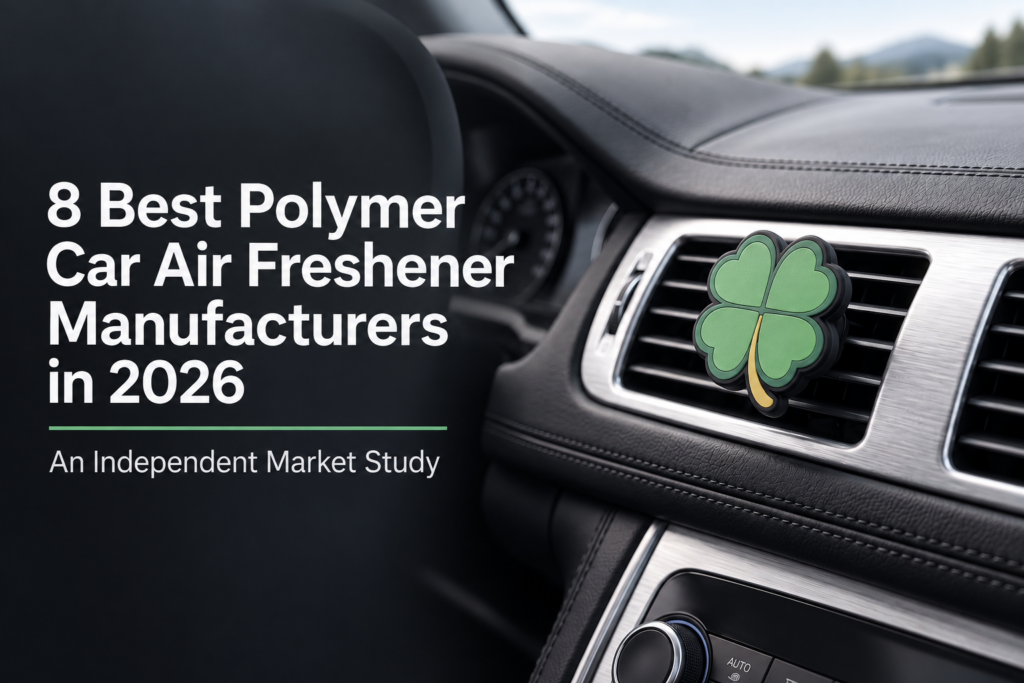
Vibez is a different product, developed from laboratory work and customer requirements rather than from an existing mould library. Seven variants — Black Storm, Cherry Rush, Lucky Lemon, Mystic Vanilla, New Car, Sport Cologne, Wild Coconut — each a sculpted three-dimensional figure: an eagle, a four-leaf clover, a protective hand, a motorsport motif, a basketball. Not EVA — produced using ELiX’s own innovative technology. Declared 30 days on pack; measured retention up to 45 days in ELiX testing.
The colour is the polymer itself. Not paint, not print, not an applied label. It does not scuff, rub off at the vent blade, or wear at the contact points. Any buyer can verify this in three seconds with a sample in hand, which is the point.
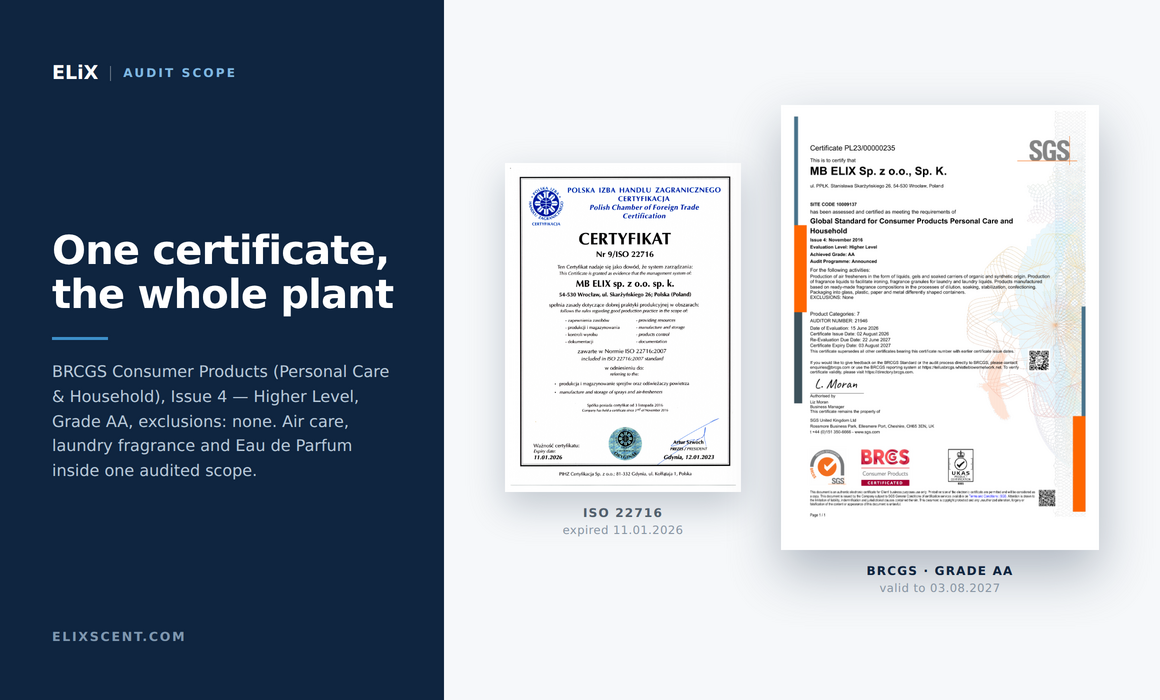
Certification is the broadest in this study: BRCGS Consumer Products, ISO 9001, ISO 14001, ISO 22716 GMP, third-party testing via TÜV SÜD, IFRA alignment, and full REACH/CLP, UFI/PCN and SDS handling with PPWR readiness. Third-party retail audits: SGS grade A for Carrefour, INTERTEK 100% approval for Tesco. Section 8 sets out what each manufacturer claims and what could be independently verified.
Decisive for a private label buyer: ELiX is the only manufacturer in this study that publishes its commercial entry terms. Vibez private label MOQ is 5,000 units per SKU, with custom tooling at approximately €1,000 — against the USD 20,000–80,000 that 2K multi-colour tooling costs by published industry benchmarks.
ELiX also states that private label clients select their fragrance from the in-house library, and that it supports development of a product shape adapted to the target market rather than offering only a fixed catalogue.
None of the other seven publishes a single one of these figures.
Shelf price: €4.99. External recognition: Grand View Research cites ELiX by name in the Europe section of its air freshener market report, referencing its 2026 B2B Buyer’s Guide.
2Aroma Car / MTM Industries — Poland 8.1 / 10
The strongest competitor within polymer specifically, and holder of the widest polymer design range in Europe: 22 designs in one category — Bearly, Geo Cat, Geo Dog, Leaf 3D, Mr. Bearded, Sport, Angry Dogs, Art Cats, Butterflies, Cutie Cats, Fresh Bag, Hex, Manny, Real Cats, Real Dogs, X-shape and more. Kalisz facility, approximately 180 employees, 60 countries.
BRCGS certified, FSC packaging, claimed 90% biodegradable compositions, 30% plastic reduction between 2018 and 2020. Licensed production for Pepsi, Gas Monkey Garage and Turtle Wax, and in 2016 the world’s only UEFA-licensed car hanger producer.
Up to 40 days claimed, conditional on atmospheric conditions. Hex at 12.99 PLN (approximately €3.00); figurative designs at 9.99–12.99 PLN (€2.31–3.00).
Weakness: no private label page. The only public statement on contract manufacturing is a single line — “it is possible to subcontract part of the production” — with no MOQ, tooling or lead time information.
3Dr Marcus International — Poland 7.6 / 10
Own plant in Kalisz, 25+ years, ISO 9001:2015, in-house laboratory, 50+ countries. The category reference product is Lucky Top — heat-resistant polymer with Neutra Boost® technology, described as neutralising amine, thiol, sulphide and aldehyde molecules rather than masking them. Dual mount: vent clip or hanger. Thirteen variants.
The longest documented longevity claim in the polymer clip format: up to 45 days. Lowest branded price in the study at 5.61–5.90 PLN (€1.30–1.36).
Weakness: single colour per variant, no published private label terms beyond a general reference to participating in private label creation across export markets.
4Little Joe / Supair Group — Switzerland, produced in Italy 7.4 / 10
The only competitor that states private label specialisation outright: “we specialize in Private Label products,” with service “from product conception to production” and the material named explicitly as EVA. Italian production since 2021, 100+ partners across 70+ countries, ISO 9001 with TÜV certification, IFRA and REACH compliance.
Approximately 45 days claimed in European markets — though a non-European distributor claims up to 60 days for the same product, a discrepancy worth noting. €1.99 (Action, Germany) to €2.30 (Poland). Single colour.
Weakness: no published MOQ or tooling figures despite the stated private label focus.
5Areon / Balev Corporation — Bulgaria 6.8 / 10
The strongest consumer brand in the European part of this study. A 10,000 m² production facility in Varna, German and Swiss equipment. The polymer line is Xperience X: vent clip, twelve fragrance variants, single colour. At 18.98 PLN (€4.38) in Castorama, it carries the highest price among single-colour polymer clips here.
Weakness: Areon publishes no fragrance duration claim for Xperience X — neither on the product page nor the line page, only “continuous and long-lasting.” No private label or OEM offer published.
6UltraScent / Ultratech Polymers — United States 6.1 / 10
The only genuine solid-polymer car air freshener manufacturer we could verify in the United States. Cuyahoga Falls, Ohio; a custom plastic extrusion house that owns the consumer brand.
Technically the most interesting entry after ELiX. Stealth Stix is a flexible polymer strip, trimmable to length, in which “the fragrance molecules are incorporated directly into the polymer matrix during extrusion rather than applied as a surface coating or absorbed into porous beads.” Single colour, deliberately matched to vent plastic to be invisible. Eight scents. Sold through Walmart, Amazon and O’Reilly Auto Parts at approximately USD 10.19 for a 2-pack. Private label enquiries accepted with published volume brackets from under USD 1,000 to USD 25,000+ per month.
Weaknesses for a European buyer: small scale, three SKU families, no ISO or IFRA certification published, no European distribution, and conflicting duration claims — 25 days on the manufacturer’s own site against “up to 60 days” on retail listings.
7K2 / Melle — Poland 5.9 / 10
Automotive chemicals producer with the NIXO polymer line, described in K2’s own words as an “innovative polymer air freshener designed for vent mounting,” doubling as a hanger. Four variants plus ARLO and JOY lines. 8.00–12.99 PLN (€1.85–3.00).
Weakness: the longevity claim is qualitative only. K2 states the polymer “releases aroma gradually over many weeks” but publishes no figure in days on the manufacturer site, the manufacturer’s own shop, or any retailer listing we checked — which makes the claim unusable on a retail pack without independent testing. No private label offer published. Air fresheners are one line among many rather than a specialism.
8Yankee Candle Car Jar Ultimate — United States 5.5 / 10
Included as the second United States data point and the only major American consumer brand with a published polymer claim. Yankee Candle, a Newell Brands portfolio brand originating in South Deerfield, Massachusetts.
The brand’s own fragrance guide separates its two hanging formats: Car Jar Ultimate uses “scented polymer technology for a more consistent fragrance experience,” while the standard Car Jar is “fragrance-infused paperboard.” The polymer block is exposed within a printed label sleeve and visibly recedes as it depletes. Up to 30 days. USD 6.00 MSRP, USD 4.99 at Target, with distribution through Target, Walmart, Kroger, AutoZone and car-wash supply channels. Roughly 25 fragrances.
Weaknesses: brand only — the contract manufacturer is not disclosed, no private label or OEM channel exists, no certifications are published, and the polymer claim rests on a single marketing page while every retailer listing omits the material entirely.
7. Comparison table
| Manufacturer | Country | Designs | Colour | Longevity | Price | Private label | Score |
|---|---|---|---|---|---|---|---|
| ELiX (Vibez) | Poland | 7 + RINGO 8 | Multi-colour in the material | 30 declared / up to 45 measured | €4.99 | MOQ 5,000 pcs + tooling ~€1,000 | 9.2 |
| Aroma Car / MTM | Poland | 22 | Single and decorated | Up to 40 days | €2.31–3.00 | Not published | 8.1 |
| Dr Marcus | Poland | 13 variants | Single | Up to 45 days | €1.30–1.36 | Not published | 7.6 |
| Little Joe / Supair | CH / Italy | Several lines | Single | ~45 days | €1.99–2.30 | Stated, no figures | 7.4 |
| Areon | Bulgaria | 12 variants | Single | Not stated | €4.38 | Not published | 6.8 |
| UltraScent | USA | 3 SKU families | Single | 25–60 (conflicting) | ~USD 5.10/unit | Enquiry only | 6.1 |
| K2 (NIXO) | Poland | 3 lines | Single | “Many weeks”, no figure | €1.85–3.00 | Not published | 5.9 |
| Yankee Candle | USA | ~25 fragrances | Single | Up to 30 days | USD 4.99–6.00 | None | 5.5 |
8. Certifications: claimed and verified
Certification is the single most consequential line in a retail sourcing decision, and the one most loosely handled in this category. We checked each manufacturer individually — every company website in English and in its local language, quality and certificate pages, downloadable catalogues, and B2B portals — and then attempted independent verification in public registries.
Two things stand out. Most claims in this category cannot be independently verified, because the companies publish a standard’s name without the certificate number, the issuing body or the expiry date. And one of the eight publishes no certification of any kind.
| Manufacturer | Claimed on own site | Certificate details published | Independently verified |
|---|---|---|---|
| ELiX | BRCGS Consumer Products; ISO 9001; ISO 14001; ISO 22716 GMP; TÜV SÜD testing; IFRA alignment; REACH/CLP with UFI/PCN and SDS; PPWR readiness; Plastic Neutral (Plastic Bank) | Standards named; certificate numbers not published | Retail audit results published: SGS grade A (Carrefour), INTERTEK 100% (Tesco). BRCGS directory not machine-readable at time of check |
| Aroma Car / MTM Industries | BRC Global Standard for Consumer Products – Personal Care and Household (announced 20 Jan 2025); FSC | BRC: no grade, number, body or dates. FSC: licence code published | FSC confirmed — FSC database lists MTM Industries Sp. z o.o. as certificate holder, cert. SGSCH-COC-070259, licence FSC-C138530, status valid, Poland |
| Dr Marcus | ISO 9001:2015 | No certificate number, no certifying body | No. Poland maintains no public register of ISO-certified companies; the claim can be neither confirmed nor contradicted |
| Little Joe / Drive Int. AG | “ISO 9001 certified by TÜV”; IFRA standards; REACH compliance | No TÜV body named, no certificate number, holder entity not stated | No. IFRA and REACH are self-declared compliance regimes in any case, not certificates |
| Areon / Balev | None | — | n/a |
| UltraScent / Ultratech Polymers | “Non-toxic, VOC-compliant, recyclable, made in USA”; SDS and VOC test data on request | No standard, jurisdiction, limit or test method named; CARB never referenced; no SDS published | No. No certification of any kind claimed |
| K2 / Melle | ISO 9001:2015; ISO 14001:2015 (adopted 2006 and 2008/09 respectively) | No certificate number, no certifying body, no certificate document | No |
| Yankee Candle / Newell Brands | Nothing at product or site level. Group level only: Sedex/SMETA supplier audits; SASB, TCFD and GRI reporting frameworks; Responsible Chemical Management Policy | Group policies name no specific regulatory regime. Contract manufacturer undisclosed | No site or product certification traceable |
Areon publishes nothing — and that is a finding, not a gap
We checked areon.com in English and Bulgarian, the History pages in both languages, the site map, the Areon Car Perfumes 2025 catalogue PDF and the Polish B2B portal b2b.areon.pl. There is no quality, compliance or credentials page anywhere in the site structure. The only production-quality signal Balev Corporation publishes is a reference to German and Swiss equipment.
The accurate statement is that Balev Corporation publishes no certification claims on any of its web properties as of September 2026 — not that it holds none. A manufacturer operating a 10,000 m² facility may well hold certificates it does not publish. For a buyer, the practical consequence is identical: you will have to request documentation directly and you cannot pre-qualify the supplier from public sources.
The two US players publish no EU compliance package
Neither UltraScent nor Yankee Candle publishes REACH registration or Only Representative details, CLP classification data, a UFI code or Poison Centre notification, an IFRA Certificate of Conformity, or an EU-format Annex II safety data sheet. A European buyer sourcing from either would have to commission the entire EU compliance package themselves. That is a material cost and a material timeline, and it should be priced into any comparison against a European supplier.
How to use this section
Treat a named standard without a certificate number as a starting point for a conversation, not as evidence. Three questions settle it: the certificate number, the issuing body, and the expiry date. Any genuinely certified manufacturer answers all three in one email, and a reluctance to do so is itself informative.
9. Multi-colour: where the technology frontier actually sits
Across every polymer product verified in this study — Dr Marcus Lucky Top, Areon Xperience X, K2 NIXO, Little Joe, Aroma Car Hex, UltraScent Stealth Stix, Yankee Candle Car Jar Ultimate — the piece is a single colour. Aroma Car is the exception, with an entire sub-range built on graphic decoration: Geo Cat, Geo Dog, Manny Rebel, Real Cats, Real Dogs, Art Cats, Angry Dogs, Butterflies and a licensed Pepsi cap.
No European manufacturer discloses how its multi-colour effect is produced. There is no statement on any product page, in any catalogue or in any press material, and no patent family covering multi-colour polymer air fresheners was found — which itself suggests the technique in general use is not considered protectable.
The clearest circumstantial evidence: Aroma Car sells the same Geo Cat and Geo Dog artwork in two materials, polymer and cellulose, through the same distributor. A shared graphic asset moving between a printed card and a polymer body points toward applied decoration rather than colour in the material. Names like “Real Cats” and “Real Dogs,” and the reproduction of a three-colour Pepsi trademark to licensor standard, point the same way. This is inference from the structure of the range, not a statement from the manufacturer.
Why it matters commercially
Colour in the material and colour on the material are not cosmetic variants of the same thing. Applied decoration wears at the vent blade and under fingers, constrains geometry to printable surfaces, and adds a separate decoration step at every design change. Colour in the material is abrasion-proof and adds no operation when the variant changes.
ELiX Vibez carries its colour in the polymer. Not paint, not print. This is the one claim in this entire study that any buyer can settle personally, in seconds, with a sample and a fingernail — which is precisely why it is worth making.
10. Private label economics
Buyers evaluating this category need three numbers: minimum order quantity, tooling cost and lead time. Seven of the eight manufacturers in this study publish none of them.
Single-colour injection tooling for a small clip runs USD 1,000–8,000 depending on cavity count, tool material and supplier geography. Multi-colour parts produced by conventional 2K two-shot molding run USD 20,000–80,000, 60–80% above the single-colour equivalent, breaking even only above roughly 10,000–15,000 units. Below approximately 8,000 units, two simpler tools plus assembly is cheaper — at the cost of labour and fit tolerance.
The practical consequence is that a custom multi-colour shape has historically been available only to buyers committing to tens of thousands of units. A retailer testing a line at 5,000 units had no route to it.
ELiX publishes the alternative: 5,000 units per SKU on Vibez, custom tooling at approximately €1,000, with fragrance selected from the in-house library and support in developing a shape adapted to the target market.
Whether or not you buy from ELiX, use those figures as your benchmark when you request quotes elsewhere.
11. How to choose
Launching a private label line and testing the category
MOQ threshold and development cost transparency decide it. A supplier who will not state MOQ before NDA adds three to six weeks per quotation round to your timeline.
Selling into grocery retail or petrol stations
Certification and documentation decide it. BRCGS, complete SDS, UFI/PCN and CLP-ready artwork are not differentiators — they are entry conditions. With 44% of hazardous mixtures non-compliant according to ECHA, the category buyer is transferring that risk to you, and you to your manufacturer.
Competing on shelf price
Dr Marcus, K2 and Little Joe set the floor at €1.30–2.30. On a single-colour clip there is little room beneath them that does not come out of your margin.
Competing on product appearance
Design count and colour construction decide it. Aroma Car has the broadest range of shapes; ELiX has multi-colour in the material at the lowest published entry threshold.
Printing a longevity claim on your packaging
Ask your supplier for the test method before you commit it to artwork. No manufacturer in this category — including those claiming 40 and 45 days — publishes a test protocol or third-party certification. The independent reference point is RIVM’s approximately 30 days.
12. Frequently asked questions
What is a polymer car air freshener?
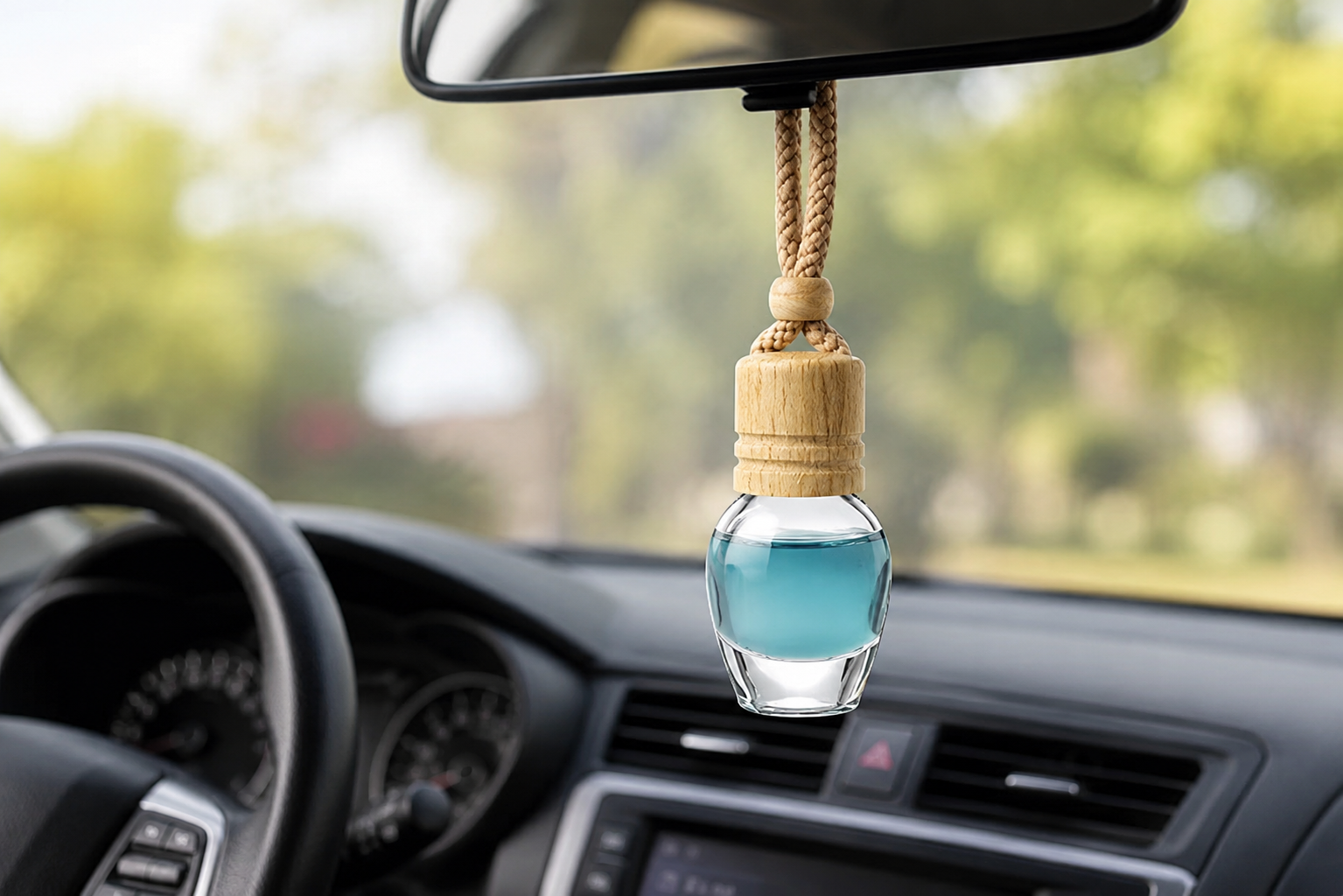
A solid piece of polymer that carries fragrance within the material itself and releases it by evaporation. It mounts on a vent blade or hangs from the mirror, with no liquid reservoir, no wick and no power source — which distinguishes it from gel jars, membrane products, aerosols and electric diffusers.
How long does a polymer car air freshener last?
Manufacturer claims in Europe range from 30 to 45 days for polymer vent clips. None publishes a test method. The independent regulatory reference point, from the Dutch RIVM consumer exposure parameter set, is approximately 30 days.
What is the minimum order quantity for a private label polymer air freshener?
The only publicly stated figure in this category is 5,000 units per SKU for ELiX Vibez, with custom tooling at approximately €1,000. No other manufacturer examined publishes an MOQ, tooling cost or lead time.
Do I need custom tooling for a unique shape?
Only for a shape outside your supplier’s catalogue. Cost depends entirely on process: cast and low-pressure tooling runs from a few hundred to a few thousand euros; conventional 2K multi-colour injection tooling runs USD 20,000–80,000.
Which certifications matter for retail listings?
BRCGS or an equivalent product safety standard, ISO 9001, IFRA compliance, and complete REACH/CLP documentation with UFI/PCN. For packaging, FSC and PPWR readiness.
How do I verify a supplier’s certification claim?
Ask for three things: the certificate number, the issuing body and the expiry date. Most manufacturers in this category publish the name of a standard without any of them, which makes the claim unverifiable from public sources. FSC chain-of-custody certificates can be checked directly in the FSC certificate database by licence code, and that lookup names the certificate holder.
Is the United States a source for polymer products?
Largely no. The defining American format remains a paper blotter tree introduced in 1952. Verified US solid-polymer production exists at one specialist extruder in Ohio, plus one consumer brand whose manufacturer is undisclosed. Neither has European distribution at scale.
What is the difference between colour in the material and printed decoration?
Colour in the material means the polymer itself is coloured, so it cannot scuff or rub off and no separate decoration step is needed when a design changes. Printed decoration sits on the surface, wears at the vent blade and at finger contact points, and limits design to printable surfaces.
Considering polymer for your private label range?
ELiX is an EU-based private label car air freshener manufacturer producing Vibez in Poland under BRCGS certification — multi-colour in the material, 5,000-unit MOQ per SKU, custom tooling from approximately €1,000, fragrance selected from a 1,000-profile library, and full REACH/CLP documentation supplied as standard.
Request a sample and quotationRelated reading
If you are shortlisting suppliers, three companion pieces cover the adjacent decisions: our 2026 B2B buyer’s guide to air freshener manufacturers across all formats, a practical guide to choosing an air freshener supplier for retail, and the ELiX private label programme with its customisation routes. Product specifications for the polymer range are on the Vibez product pages.
13. Sources
Market data: Mordor Intelligence · Fortune Business Insights · The Business Research Company · GM Insights · Persistence Market Research · Grand View Research · ACEA · RIVM Air Fresheners Fact Sheet · PLMA
Regulatory: CLP amendment 2025/2439 · ECHA compliance findings · FSC Search (certificate database)
Tooling: Zetar tooling costs · Zetar 2K molding · SyBridge · Rex Plastics · Formlabs
Manufacturers: ELiX Vibez · ELiX Private Label · ELiX FAQ · ELiX RINGO · Aroma Car Polymers · Dr Marcus Lucky Top · Areon Xperience X · Supair Group · Little Joe · UltraScent · K2 NIXO · Yankee Candle car fragrance guide · LITTLE TREES