Company info / Air Fresheners
EU vs Asian Air Care Manufacturers: The 2026 Sourcing Comparison Guide
The sourcing question stopped being about cost per unit years ago. Most distributors haven’t updated the mental model yet. That is the honest starting point of this piece, and everything else we would say about European versus Asian manufacturing follows from it.
We have made air care in Poland for twenty-five years. In that time we have watched the same conversation come round the room again and again. A distributor lands with a landed-cost sheet from an Asian OEM. The number looks impressive. Six months later they are back, quieter this time, asking whether we could take over a range that never quite worked. Sometimes it was the fragrance. Sometimes it was a retailer compliance query the factory could not answer in time. Sometimes it was a small formulation change that turned into a three-month project. The pattern is not new. What has changed is how expensive the pattern now is, and how precisely that cost can now be measured.
In short:
- Two hard EU compliance deadlines land within three weeks of each other in 2026: mandatory labelling of 56 new fragrance allergens from 31 July, and the first PPWR packaging conformity deadline on 12 August, with penalty exposure over €500,000 and no grace period.
- Freight is no longer a rounding error. Asia-Europe ocean routes are still rerouting around the Cape of Good Hope in mid-2026, adding 10-14 days of transit and running 25-40% above pre-disruption freight rates, which stretches typical order-to-delivery cycles from roughly five weeks to seven to ten.
- EU-based documentation (REACH, CLP, UFI/PCN, IFRA, SDS) is built into the launch brief at a certified European site, not corrected after a retailer flags it, which is the difference between weeks and months when a regulation changes mid-cycle.
- Every solvent and preservative in an EU-made formula has to come off a published, tested safe list before it goes in. Some raw materials still common in Asian-manufactured air care and fabric fragrance, musk xylene among them, are outright banned in the EU.
- Compare the two sourcing routes side by side before the next PO, not after a range underperforms.
The Detail That Decides It
The detail matters, because the detail is where distributors either save money or lose it. Five areas do most of the work.
Documentation
When we ship a formula, the paperwork ships with it. That is not a marketing point. It is what any factory audited to BRC and ISO for long enough should have as muscle memory. In practice, an EU-shipped consignment arrives with:
- A REACH file reconciled to the exact composition, not a template with the numbers changed.
- CLP labelling designed in at brief stage, not corrected after a retailer flagged it.
- A UFI code on the pack because the PCN submission was part of the launch.
- A fragrance written to sit inside current IFRA limits from the first sample.
- Safety data sheets ready in the languages the buyer’s markets actually need.
An Asian OEM can produce all of this when pushed. The push is where distributors lose weeks they cannot get back. For a sense of what that documentation load looks like at scale, we’ve written separately about , the same infrastructure that lets a launch brief include compliant artwork from day one rather than after a retailer sends it back.
Raw Material Safety: Solvents and Preservatives
This is the point that sits underneath the documentation, not alongside it. In the EU, every solvent and preservative used in an air freshener, gel, or laundry fragrance has to come from a published, regularly updated safe list, the Cosmetics Regulation’s own prohibited- and restricted-substance annexes, backed by REACH. A raw material does not go into an EU-made formula because it is cheap and works. It goes in because it has already been tested and cleared for that exact use, at that exact concentration. That bar is not universal, and the gap shows up in specific, named substances, not abstractions.
Take musk xylene. For decades it was a standard nitro-musk fixative in air fresheners, fabric conditioners, and fine fragrance, prized for a long-lasting “clean laundry” note at a low cost. The EU banned it under REACH after it was classified as a suspected carcinogen and shown to persist and accumulate in the environment. Production has not stopped globally, it continues in China and India, and the substance is still used in a range of household products, including air care and fabric fragrance, sold outside the EU. A distributor sourcing a long-lasting “fresh linen” or car-freshener note from an OEM working outside the EU’s regulatory net has no structural guarantee that the fixative behind that scent would clear an EU safety file at all.
Preservatives follow the same pattern. Formaldehyde’s intentional use as a cosmetic and household-product preservative is banned outright in the EU as a carcinogen and skin sensitiser; formaldehyde-releasing preservatives are permitted only under strict limits and, since July 2024, must carry a “releases formaldehyde” warning label once release levels pass 0.001%. Five parabens, isopropyl-, isobutyl-, phenyl-, benzyl-, and pentylparaben, have been banned outright in the EU since 2014. Formulators building to EU limits design a preservative system around what is left on the approved list from the first sample. Formulators building to a looser or inconsistently enforced standard do not carry that constraint, and a distributor usually only discovers which formula they were sold when a retailer’s own compliance lab tests it.
None of this is a paperwork gap. It is the difference between a factory that starts formulation from “what is cleared for use in the EU” and one that starts from “what works and is cheap,” checking the list only if a customer asks.
Fragrance
Air care is fragrance, and fragrance is where Europe has an advantage most people still underestimate. The European fragrance houses are here. The perfumery tradition is here. The regulatory framework the houses work under is the same one European retail sells into.
When we brief a scent, we brief it into a system that already speaks the same language as the shelf it will end up on. Manufacturers who go further and build their own aroma formulation capability, which is what our Aroma Formulation Labs exist to do, can develop signature scents no OEM working from a catalogue is going to reproduce. That is not a marketing claim. It is a structural fact about where perfumery lives.
Proximity, Measured in Weeks
Not freight time in the abstract, though it is no longer trivial. As of mid-2026, container carriers are still routing most Asia-Europe traffic around the Cape of Good Hope rather than through the Red Sea and Suez Canal, and industry forecasts expect that to continue into 2027. That reroute adds roughly 10 to 14 days of transit on top of the pre-disruption schedule, and Asia-Europe freight rates are still running 25-40% above where they sat before the crisis. A lane that used to run on a five-week cycle is now closer to seven, and sourcing teams are being told to plan booking lead times of four to six weeks just to secure space.
None of that shows up on a landed-cost spreadsheet built around unit price. All of it shows up on a shelf date. Proximity to an EU manufacturer is proximity to the buyer’s regulatory reality and the buyer’s working day, and it is also, in 2026, several fewer weeks of ocean freight risk sitting inside the launch plan. The distributors who have partnered with us longest tend to be the ones who have visited more than once. That is not an accident. It is what happens when a supplier is close enough to know rather than close enough to guess.
Category Depth
This is the one that is hardest to explain until the moment you need it. European specialists in air care have accumulated the quiet expertise that only surfaces when a project goes sideways.
A reformulation that has to protect a scent character through an IFRA change. A gel base that has to survive a warmer market without slumping. A format nobody has built at scale before. None of this is what a distributor buys on day one. It is what a distributor is grateful for, in year three.
EU Manufacturer vs Asian OEM: A Side-by-Side Comparison
| EU-based manufacturer (e.g. ELiX, Poland) | Typical Asian OEM | |
|---|---|---|
| Compliance documentation | REACH, CLP, UFI/PCN, IFRA and SDS built into the launch brief, delivered with the first sample | Produced on request; often corrected only after a retailer flags a gap |
| Solvents & preservatives | Formulated only from substances cleared on the EU’s own safe lists (Cosmetics Regulation Annexes, REACH) | Some raw materials common outside the EU, e.g. musk xylene, several parabens, are outright banned in the EU |
| Response to a regulatory change | Formula archive and scheduled reviews; reformulation typically measured in weeks | Reactive; can take months once a change lands, with output held up in the meantime |
| Fragrance development | Direct access to EU perfumery houses and in-house aroma labs, working to the same regulatory limits as the shelf | Catalogue-sourced, cost-optimised scents; slower iteration on retailer feedback |
| Freight lead time (2026) | Days; a factory visit is a day trip | Cape of Good Hope reroute adds 10-14 days transit; 4-6 week booking lead times |
| Freight cost (2026) | Domestic EU logistics | Asia-Europe rates running 25-40% above pre-2024 levels |
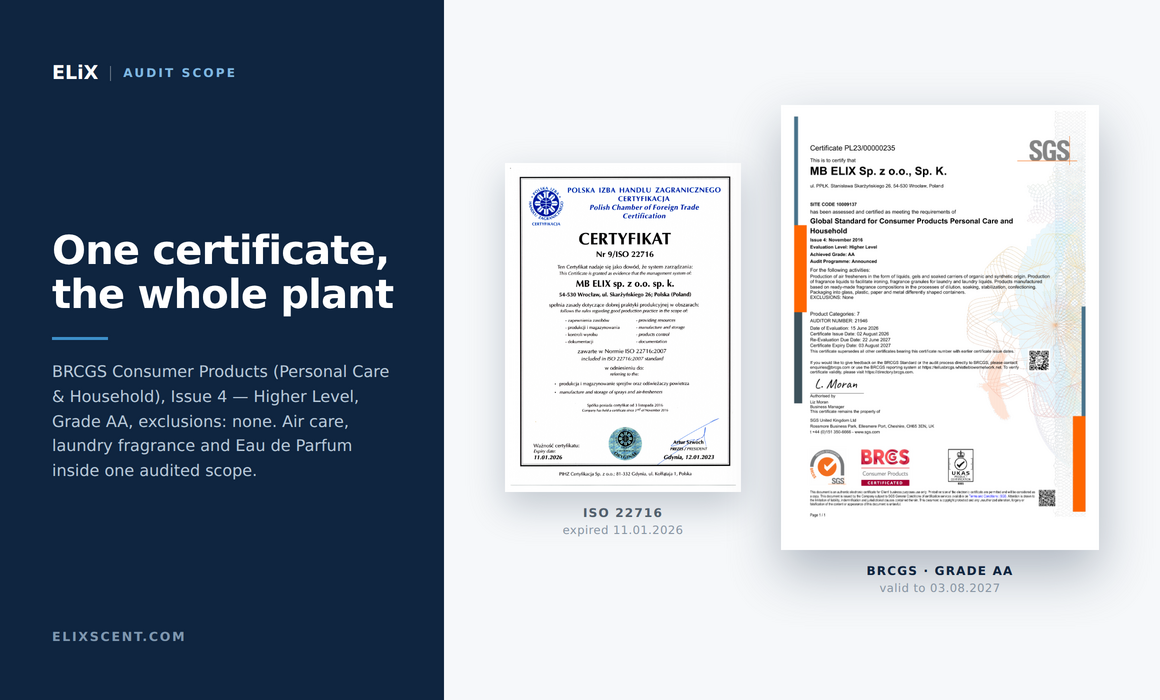
| Retail audit substitute | Live BRC/ISO certificate a retailer can accept in place of its own factory visit | Certification history less consistently recognised by EU retail compliance teams |
| Category expansion | One documentation stack across air care, laundry, fine fragrance and essential oils | Often single-category; expansion usually means qualifying a new supplier |
The Read for 2026
There is a version of this conversation where all of the above sounds like the European manufacturer arguing its own book, and we understand why. So look at what is on the calendar instead of what we say about it. Two EU compliance deadlines land within three weeks of each other this summer, and neither is hypothetical.
From 31 July 2026, cosmetic and fragrance products placed on the EU market must disclose 56 additional fragrance allergens on the label, on top of the 26 already required, a threefold expansion of the allergen list under the amended Cosmetics Regulation. From 12 August 2026, the EU’s new Packaging and Packaging Waste Regulation requires a signed declaration of conformity on file for every packaging reference placed on the market, with penalty exposure above €500,000 and no grace period. The two changes converge on the same artwork: brands are rewriting fragrance disclosures and redesigning packaging compliance documentation in the same cycle.
A factory that treats regulatory change as a scheduled review, rather than an emergency each time it happens, absorbs a deadline like this inside its normal production calendar. A factory that treats it as a one-off request needs the distributor to chase it, usually while an Asian shipment carrying the old label is already somewhere off the coast of Africa on the long route home. This is not a one-time event either. A McKinsey survey of supply chain leaders in May 2025 found 82% had already had their supply chain affected by new tariffs, and European industry surveys through 2026 show a majority of manufacturing executives now running, or actively building, a reindustrialisation strategy for exactly this reason. There is always another one coming.
The unit-cost gap on paper is smaller than it looks once freight, documentation turnaround, and reformulation risk are honestly priced in for 2026 conditions. The distributors who see this early are the ones building categories that hold up when the next regulatory tightening lands. The ones still comparing suppliers on landed cost per unit are the ones who will spend the next couple of years watching their category share drift toward competitors who stopped comparing that way a while ago. That is the plain version. The rest is timing.
Frequently Asked Questions
Why Should Distributors Source Air Care From EU Manufacturers Instead of Asian OEMs?
EU manufacturers deliver a compliance and quality package that Asian OEMs typically produce only when asked, which costs the distributor weeks or months per project. European air care factories ship with REACH files, CLP labelling, UFI codes, and IFRA-compliant fragrances built into the launch process rather than added afterwards. Proximity to European fragrance houses also shortens scent development cycles significantly, and in 2026 EU sourcing avoids the Asia-Europe freight delays created by the ongoing Red Sea shipping disruption. For distributors selling into European retail where regulatory scrutiny is part of the buyer conversation, EU sourcing reduces documentation risk, launch delays, and reformulation cost across a full range.
What Compliance Documents Do EU Air Care Manufacturers Provide as Standard?
A serious EU air care manufacturer ships each product with a REACH file matching the exact formulation, CLP-compliant labelling, a UFI code linked to a submitted PCN dossier, IFRA compliance certificates for the fragrance, safety data sheets in the required market languages, and audit-grade certifications such as BRC Consumer Products and ISO 9001. These are not add-on services. They are part of the launch workflow. Distributors sourcing in the EU can expect the compliance package to arrive alongside the invoice, not weeks after, which shortens retailer onboarding significantly.
What Are the July 2026 and August 2026 EU Deadlines That Affect Air Care Sourcing?
From 31 July 2026, the EU’s amended Cosmetics Regulation requires disclosure of 56 additional fragrance allergens on cosmetic and fragrance product labels, expanding the mandatory list from 26 to 82 for products newly placed on the market (with a further deadline of 31 July 2028 for products already on shelf). From 12 August 2026, the EU’s Packaging and Packaging Waste Regulation (PPWR) requires a signed declaration of conformity on file for every packaging reference sold in the EU, with penalty exposure above €500,000 and no grace period. Both deadlines require reworked labelling and packaging artwork in the same window, which is far easier to absorb through a manufacturer already running scheduled regulatory reviews than through a one-off request to an overseas OEM.
How Does Fragrance Quality Differ Between EU and Asian OEM Air Care?
European air care manufacturers work directly with European fragrance houses under the same regulatory framework as EU retail, which means faster iteration and finer scent matching for European consumer expectations. Asian OEMs often source fragrance from local catalogues that are cost-optimised rather than perfumery-led, resulting in scents that read one step behind on a European shelf. Manufacturers with in-house perfumery capability go further and develop signature scents that cannot be replicated from a catalogue. For distributors, that difference shows up as consumer preference in blind testing and category sell-through.
What Are the Hidden Costs of Sourcing Air Care From Asian OEMs in 2026?
The hidden costs of Asian OEM sourcing usually appear as documentation delays, longer reformulation cycles, working capital tied up in slower launches, and the occasional retailer conversation that goes badly because a safety data sheet or IFRA certificate arrived late or in the wrong format. In 2026, freight adds a further layer: ocean carriers are still rerouting Asia-Europe traffic around the Cape of Good Hope, adding 10-14 days of transit and running freight rates 25-40% above pre-disruption levels, which stretches a typical order cycle by two to three weeks. Individually, each cost looks minor. Across a full range, they can outweigh the unit-price advantage that made the original sourcing decision look attractive. Distributors who track total landed cost including compliance risk, freight volatility, and time-to-shelf often find EU sourcing more competitive than the sticker price alone suggests.
How Do EU Air Care Manufacturers Handle IFRA and REACH Updates?
EU air care manufacturers with established regulatory operations treat IFRA amendments and REACH updates as continuous process rather than emergency response. In practice that means running periodic formula reviews against current amendment lists, maintaining a formula archive that supports fast reformulation, and briefing fragrance houses to work within the latest limits at the outset. When a change lands, the reformulation timeline is measured in weeks rather than months. For distributors, that means less disruption to running SKUs and less risk of a listed product falling out of compliance mid-cycle.
What Solvents and Preservatives Does the EU Restrict That Asian Manufacturers May Still Use?
EU-made air care and fragrance products can only use solvents and preservatives that are cleared on the Cosmetics Regulation’s own safe lists, backed by REACH. A concrete example is musk xylene, a nitro-musk fixative once standard in air fresheners, fabric conditioners, and fine fragrance for its long-lasting “clean laundry” note: the EU banned it under REACH as a suspected carcinogen that persists and accumulates in the environment, yet production continues in China and India, and it remains in use in household products, including air care, sold outside the EU. On the preservative side, the EU has banned formaldehyde as an intentionally added preservative outright and prohibited five parabens (isopropyl-, isobutyl-, phenyl-, benzyl-, and pentylparaben) since 2014. A distributor sourcing outside the EU regulatory net has no structural guarantee that the solvents or preservatives behind a scent would clear an EU safety file, and typically only finds out when a retailer’s own compliance lab tests the finished product.