Private Label Guide · Company Info
BRC Certified European Air Freshener Manufacturers: A Distributor’s Sourcing Guide
BRC certified European air freshener manufacturers give distributors something a logo on a website cannot: audited proof that every batch leaving the factory has been produced under a controlled hygiene, traceability, and safety regime. For a distributor sizing up a new air care supplier, that audit trail is the difference between a shelf-ready programme and a compliance headache six months into the contract. This guide is written for distributors evaluating European air freshener manufacturers with real BRC accreditation. It sets out what BRC actually covers in an air care context, why it carries more weight with retail chains than a certificate like ISO 9001, how to verify a supplier’s status, which certifications should sit alongside BRC on any serious sourcing shortlist, and what a distributor partnership looks like when the factory behind it is audited to that standard.
In short:
- Most retail chains and private-label buyers never send their own auditor to a supplier’s factory. BRC is one of the very few certifications built specifically to give them that assurance instead, something ISO 9001 alone does not guarantee.
- BRC certification is granted for a site’s entire production, not a single product line. At ELiX, one certificate covers ELiX air care, Amarella laundry, HIKARI fine fragrance, and ELiX professional fragrance & essential oils, all made at the same Wrocław, Poland facility.
- The certificate is not a one-time badge. BRC sites are re-audited on a fixed annual cycle, which is stricter than the surveillance schedule of many other certification schemes.
- For a consumer goods factory, BRC audited to an A or AA grade is close to the ceiling of third-party assurance. There isn’t a materially higher bar most retail chains or serious private-label clients will ask a supplier to clear. ELiX itself is certified at AA, the highest grade a BRC site can hold, audited by SGS under the Higher Level evaluation.
What BRC Certification Actually Means for Air Freshener Production
The BRC Global Standard began in food safety, but its Consumer Products variant is the framework that applies to air fresheners, gels, room sprays, refills, and car formats. In practice, certification means a factory has been independently audited on a defined cycle against a published standard covering hygiene control, raw material traceability, allergen management where relevant, batch record keeping, complaint handling, corrective action systems, and senior management commitment to product safety.
For an air care plant, that translates into concrete daily discipline:
- Fragrance concentrate and raw material suppliers are approved and monitored, not chosen ad hoc when a batch runs short.
- Every production run of gel, spray, or refill is traceable to its component lot numbers.
- Cleaning schedules, line changeovers, and product contact surfaces are documented, not left to shift memory.
- Complaints and non-conformances feed into a closed corrective action loop that the auditor can inspect.
- Internal audits happen on a fixed cadence, not only in the weeks before the external audit.
- The external certification audit itself is renewed every 12 months, not every two or three years as with several other certification schemes. A live BRC certificate is always recent evidence, not a lapsed one.
Distributors care about this because a BRC audit gives them defensible provenance. When a retail buyer, a national authority, or a private-label client asks how the product was made, the answer is documented, not asserted. That single fact is often the reason a distributor wins a listing with a serious retailer over a competitor sourcing from a non-audited factory.
Why BRC Sits at the Top of a Distributor’s Sourcing Checklist
Here is the commercial reality most distributors learn the hard way: the large majority of retail chains and private-label owners never send their own auditor to a supplier’s factory floor. They do not have the headcount to do it for every own-brand supplier, and for most categories they do not need to, because BRC exists to do that job on their behalf. That is what separates BRC from a quality-management certificate like ISO 9001. ISO 9001 confirms that a company has documented processes and follows them; on its own, it does not verify hygiene control, raw material traceability, or batch-level product safety at the depth a retailer buying a private-label air freshener actually needs. BRC does exactly that, which is why serious retail chains and private-label programmes treat a live, in-scope BRC certificate as a condition of listing rather than a nice-to-have, and why it is one of the very few certifications that gives a retail chain real certainty and a genuine quality guarantee without anyone from their own team setting foot in the plant.
A distributor’s exposure runs from the factory gate to the retail shelf. If the manufacturer skips corners on ingredient sourcing, batch control, or complaint handling, the distributor absorbs the return, the retailer chargeback, and the reputational cost. BRC certified European air freshener manufacturers reduce that exposure in three concrete ways.
First, the audit is graded, time-bound, and renewed annually. A supplier holding an AA or A grade has been externally reviewed against a published standard every year, not self-declared and not re-checked only every few years. A lapsed certificate is easy to spot because the cycle is short.
Second, BRC dovetails with the wider framework European air care distribution actually requires. ISO 9001 for quality management, ISO 14001 for environmental control, and in some plants TÜV SÜD process audits typically sit alongside BRC in a mature manufacturing base, but none of those replace what BRC verifies. A factory that has already committed to BRC has usually built the rest of the certification stack around it, which shortens the vetting process for the distributor.
Third, BRC-aligned documentation makes downstream regulatory work faster. UFI codes, PCN submissions, CLP labelling, IFRA compliance for each fragrance, and REACH substance data all rely on the same traceability infrastructure the BRC audit checks. In our experience, that saves weeks of paperwork when a distributor moves a product into a new EU market or responds to a national poison centre query.
For a manufacturer producing FMCG fragrance products, BRC audited to an A or AA grade is effectively as far as third-party certification goes. There is no materially higher bar most retail chains or private-label programmes will ask a supplier to clear, which is exactly why it belongs at the top of the checklist, not alongside it.
How to Verify a BRC Certified Air Freshener Supplier
Anyone can claim certification. Distributors need to verify it before a purchase order is written. This is the practical process we recommend to buyers who ask us how to vet a supplier they have not worked with before.
- Ask for the certificate itself. Not a web-page logo. A dated PDF from the certification body, showing scope, site address, grade, and expiry date.
- Check the BRCGS public directory. BRC maintains an open register of certified sites. If the supplier is not listed with a live status, the certificate is not current.
- Confirm the scope matches your category. BRC certification is granted for specific product categories at a specific site. A factory certified for household cleaning may not carry scope for aerosol air fresheners or car formats. Read the scope statement on the certificate.
- Check the audit grade and last audit date. An A grade with a recent audit is a stronger signal than a C grade from eighteen months ago, and because BRC recertifies annually, that audit date should never be more than a year old.
- Request the supplementary certifications. ISO 9001, ISO 14001, and any TÜV SÜD process audit reports. A serious manufacturer will send them without hesitation, along with sample SDS, IFRA, and CLP documents for a representative SKU.
Buyers evaluating the ELiX air care catalogue receive this documentation package as standard at the enquiry stage. Our position is straightforward: a distributor should not have to chase a certificate. It should arrive with the first sample brief, together with the fragrance library, the format catalogue, and the MOQ grid.
What Product Categories a Certified European Manufacturer Should Cover
A BRC certified factory earns its cost premium on two dimensions, and distributors should check them separately: what the audit scope actually covers at the site, and whether the format range within that scope is deep enough to build a category.
What the BRC Scope Actually Covers at ELiX
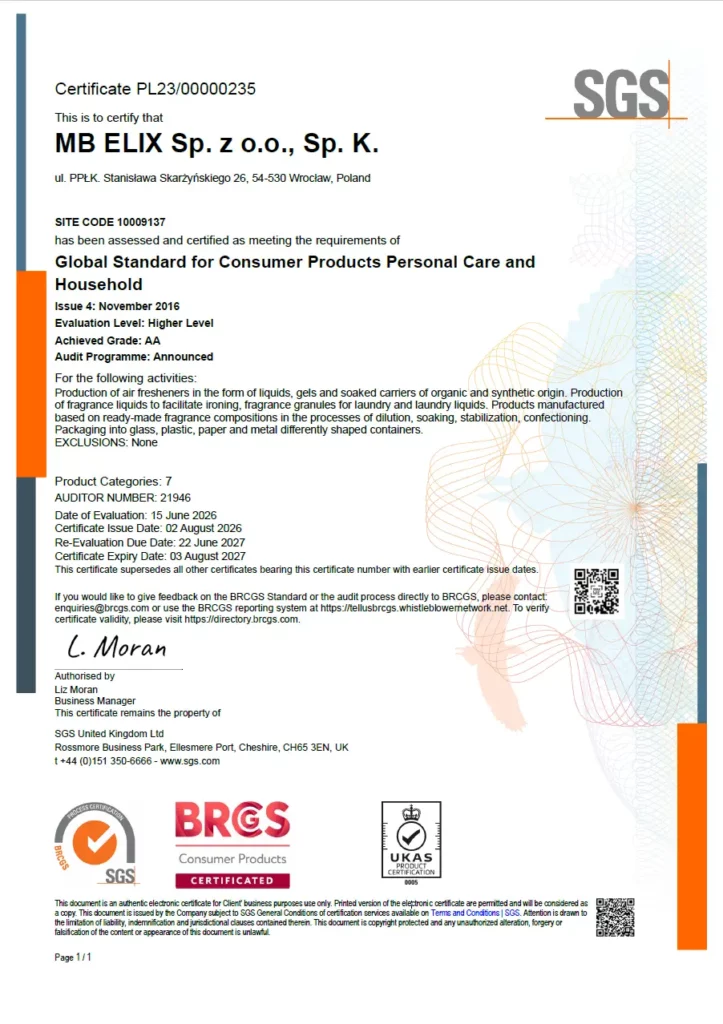
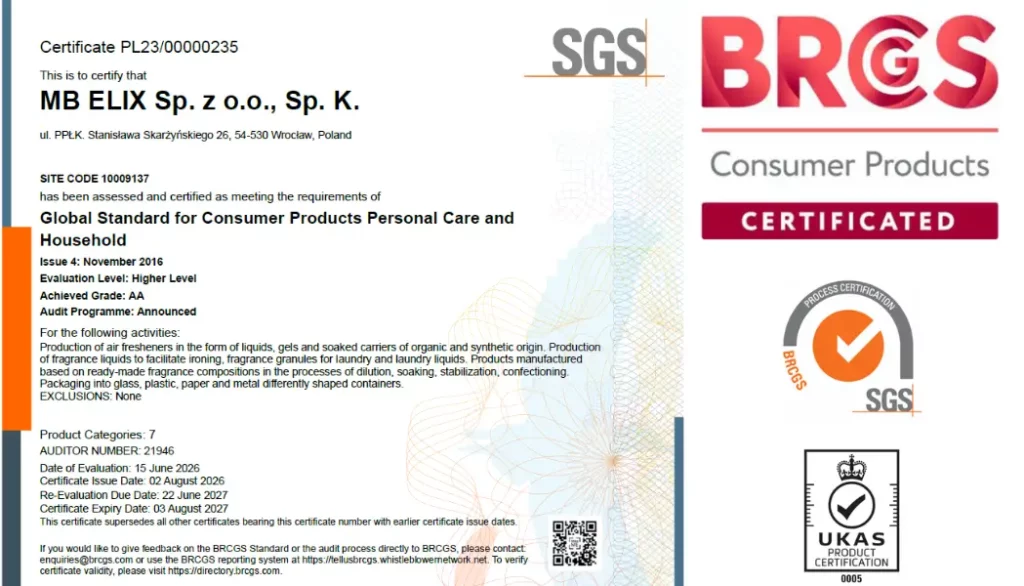
BRC certification is granted for a site’s entire production output, not a single product line, so a serious buyer should ask exactly what sits inside that scope, and ask to see the certificate itself rather than take a claim on trust. ELiX’s current certificate is a matter of public record:
- Certificate number: PL23/00000235
- Certifying body: SGS United Kingdom Ltd (UKAS-accredited)
- Standard: BRCGS Global Standard for Consumer Products, Personal Care and Household, Issue 4
- Evaluation level: Higher Level
- Achieved grade: AA, the highest grade a BRC site can hold
- Product categories in scope: 7
- Current validity: issued 11 August 2025, valid to 3 August 2026, with the next audit due ahead of expiry to keep certification continuous
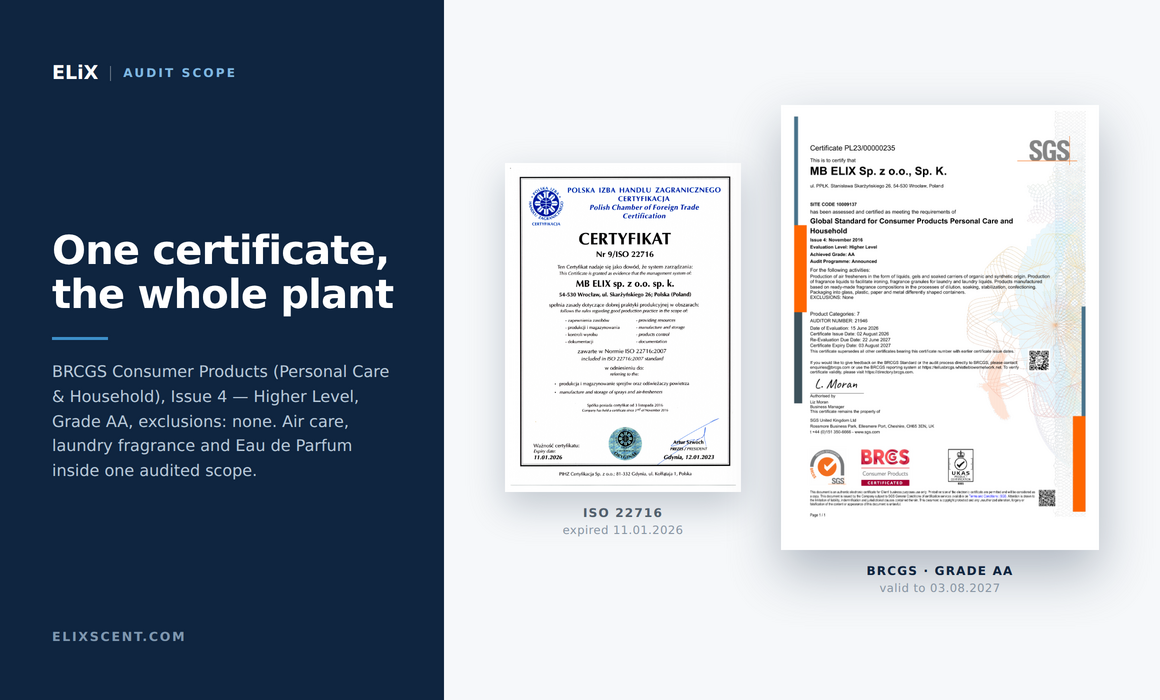
ELiX holds this certification across the full production output at the Poland manufacturing base, on a single audit covering:
- ELiX FMCG air care: gels, membrane fresheners, sprays, refills, car formats, and aerosols.
- Amarella laundry programme: laundry washing gel, fabric conditioner, and in-wash scent boosters.
- HIKARI Eau de Parfum and fine fragrance production.
- ELiX Professional Fragrance & Essential Oils: natural essential oil blends, perfumery-grade diffuser oils, and functional scent-marketing oils for hospitality, retail, and wellness diffusion.
For a distributor focused on air care, the multi-category scope carries two practical signals:
- Manufacturing discipline strong enough to hold one certification across processes as different as aerosol filling, cold-mix laundry compounding, alcohol-based fine fragrance, and cold-air diffusion oil production.
- Room to expand category conversations later, into laundry, fine fragrance, or professional scenting oils, without triggering a new supplier vetting cycle, because the same certificate already covers it.
Why the Audit Skip Matters to Hypermarket and Private Label Buyers
This is where BRC delivers its most commercial line for distributors. Hypermarket buyers and private label owners typically require an on-site factory audit before listing a new supplier, but in practice, most of them never carry it out themselves. A live BRC certificate is accepted in place of that audit by most European retail chains and by the majority of serious private label operators, because their compliance teams treat the BRC audit as the standard they would otherwise send their own auditors to replicate. For a category where the retailer’s own brand reputation is on the line and no one from their team has walked the factory floor, BRC is effectively the only independent guarantee they have, and unlike ISO 9001, it is a guarantee built around the product leaving the line, not just the paperwork behind it.
For the distributor, that removes:
- Weeks of coordination scheduling a retailer or private-label audit team.
- Travel costs and audit fees loaded into the cost of a new listing.
- Back-and-forth on corrective action reports before a purchase order is issued.
- Time-to-shelf slippage that pushes a launch out of its promotional window.
For distributors with pressure on shelf date, this is often the single most valuable line on the certificate. It is also why experienced hypermarket buyers treat BRC as a hard requirement, not a nice-to-have.
Format Range Within the Air Care Scope
For distributors building a serious air care shelf, coverage typically means:
- Membrane and gel air fresheners for home and vehicle use.
- Room sprays and mist formats in retail-ready packaging.
- Car air fresheners in vent, hanging card, and clip formats.
- Refills for open-system diffusers and continuous-use devices.
- Aerosol air fresheners where the plant is licensed for pressurised filling.
- Reed diffusers and passive room formats for premium retail placements.
Why Category Depth From One Source Pays Off
In our experience, distributors who load a full fragrance category from one BRC-audited European partner see three practical gains:
- Less parallel compliance work, because one factory covers one documentation stack across air care, laundry, fine fragrance, and essential oils.
- Less multi-supplier logistics load on the buying team.
- Less reconciliation of different fragrance libraries against local IFRA rules.
One certified source, one audit file, one documentation pack, one commercial contact. That is the operational reality behind the sourcing decision, and it usually shows up in landed cost and shelf speed within the first two quarters.
Range depth is only useful if the fragrance work behind it can hold its own on shelf. Because ELiX also produces fine fragrance and professional scenting oils, the fragrance libraries applied to gels, sprays, and car formats are built by the same aroma chemists working on Eau de Parfum and hospitality-grade compositions. For a distributor, that means the air care products carry a scent profile that survives blind comparison against premium retail shelves, not a flat top-note that fades in a fortnight. Certification proves the process. Perfumery depth is what earns repeat purchase at the till.
What a Distributor Partnership With a BRC Certified Factory Actually Looks Like
Certification only reaches the distributor’s P&L if the commercial framework around it is set up to release it. This is where the biggest gap in the market shows up. Plenty of factories are audited. Fewer are set up to serve distributors properly. A workable partnership with a BRC certified European air freshener manufacturer should include a defined set of terms from the outset.
- A clear cooperation model. White label from an existing catalogue, custom private label with fragrance and packaging development, or contract manufacturing under the distributor’s own brand. Each has different lead times and costs.
- MOQ transparency. Different formats carry different minimums. A serious factory publishes them or communicates them clearly on the first call, not after three rounds of negotiation.
- Territorial clarity. Whether the arrangement includes exclusivity for a market, a channel, or a category, and on what commercial terms.
- A full documentation package. Safety data sheets, CLP-compliant artwork, UFI codes, PCN reference numbers, IFRA statements per fragrance, and BRC certificate copies. Delivered as standard, not on request.
- A sample-to-shelf timeline commitment. How long from brief acceptance to first commercial delivery, with milestones for R&D at the in-house Aroma Formulation Labs, sampling, artwork sign-off, and production slot.
Buyers evaluating our distributor partnership programme receive this framework laid out at the enquiry stage. That removes the guesswork that usually eats the first two months of a new supplier relationship, and it keeps the audit-backed provenance connected to the commercial deal rather than filed separately.
Building a Sourcing Shortlist That Holds Up
Every distributor sourcing fragrance products in Europe should end up with a shortlist of BRC certified European manufacturers that meet the same evidence bar: verified BRC status on the public register, matching scope for the categories being distributed, ISO and TÜV SÜD certifications alongside it, REACH and CLP documentation on file, fragrance depth backed by real perfumery capability, and a cooperation model that fits the distributor’s business rather than the factory’s convenience.
ELiX has spent 25 years building the infrastructure that answers each of those checks in one place, across air fresheners, gels, sprays, refills, car formats, laundry fragrance, fine fragrance, and professional scenting oils, all under one annually re-audited BRC certificate. If your next category rollout depends on getting the sourcing right, become a distributor and get the audit-backed documentation, the category range, and the cooperation model in one conversation.
Frequently Asked Questions
Which European Air Freshener Manufacturers Are BRC Certified?
Several European air care factories hold live BRC certification, with production bases concentrated in Poland, Germany, Italy, and the UK. ELiX is a BRC certified European manufacturer operating from Poland with 25 years in FMCG fragrance, certified at AA grade (certificate PL23/00000235, audited by SGS), supplying distributors across the ELiX air care range (membrane, gel, spray, refill, aerosol, and car formats), Amarella laundry, HIKARI fine fragrance, and ELiX professional fragrance and essential oils, all covered under one BRC certificate. When shortlisting, verify each candidate against the BRCGS public directory, confirm the scope covers your product categories, and ask for the current dated certificate. A logo on a website is not evidence. The certification body PDF and directory listing together are the two checks that matter.
What Does BRC Certification Cover in an Air Freshener Factory?
BRC certification for consumer products covers hygiene control, raw material traceability, batch record keeping, complaint and non-conformance handling, corrective action systems, internal audit cadence, and senior management commitment. In an air freshener plant, that means fragrance concentrates and raw materials come from approved suppliers, every gel, spray, or refill batch is traceable to component lots, cleaning and changeover protocols are documented, and complaints feed a closed corrective action loop. The scope is granted per site and per product category, so a certificate valid for one category does not automatically cover another format at the same plant, which is why a multi-category site audit, like the one covering ELiX’s full production, is worth more to a distributor than a single-line certificate.
Does a BRC Certificate Replace a Retail Chain’s Own Factory Audit?
For most retail chains and private-label operators, yes, in practice. Hypermarket and supermarket buying teams rarely send their own auditor to inspect a new supplier’s factory; their compliance and quality teams accept a live, in-scope BRC certificate as equivalent proof instead. This is a large part of why BRC carries more weight in a listing decision than a certificate like ISO 9001, which confirms a documented quality-management system but does not, on its own, verify hygiene control, traceability, or batch safety on the factory floor. BRC is also audited and renewed every 12 months, so a current certificate is recent evidence rather than a stale one. For a consumer goods manufacturer, holding a live BRC certificate is close to the highest level of third-party assurance a retail buyer will ask a supplier to demonstrate.
How Can a Distributor Verify BRC Certification Before Signing a Supply Agreement?
The verification sequence is straightforward. Request the current dated PDF certificate from the certification body, showing scope, site address, grade, and expiry. Cross-check the site on the BRCGS public directory to confirm live status. Read the scope statement to confirm it covers the categories you plan to distribute. Note the audit grade and last audit date; a recent A or AA grade is a stronger signal than an older lower grade, and because the certification cycle is annual, that date should never be more than a year old. Then request supplementary certifications, ISO 9001, ISO 14001, and any TÜV SÜD reports, and sample regulatory documents for a representative SKU.
What Is the Typical MOQ for a BRC Certified European Air Freshener Manufacturer?
MOQs vary by format, packaging complexity, and cooperation model. White label orders from an existing catalogue carry the lowest minimums because tooling and formulation already exist. Custom private label with a bespoke fragrance and unique packaging carries higher minimums to justify R&D and artwork setup. Contract manufacturing under a distributor’s own brand sits between the two. A serious BRC certified European air freshener manufacturer publishes MOQ ranges by format on the first commercial call rather than after several rounds of negotiation, which lets the distributor model unit economics before committing to sampling.
What Other Certifications Should Sit Alongside BRC on a Distributor’s Sourcing Checklist?
BRC on its own is not the full picture, though it is the certification that carries the most weight with retail chains that audit no further themselves. A credible European fragrance supplier should also hold ISO 9001 for quality management and ISO 14001 for environmental control, with TÜV SÜD process audits where the plant scope requires it. On the regulatory side, expect full REACH and CLP compliance, UFI codes and PCN submissions in place for every EU market you plan to distribute in, and IFRA statements per fragrance. Together, these frameworks give a distributor the documentation stack a serious retailer or national authority will ask for during listing or market entry, with BRC as the certificate that answers the question a retailer’s own auditor would otherwise have to ask in person.