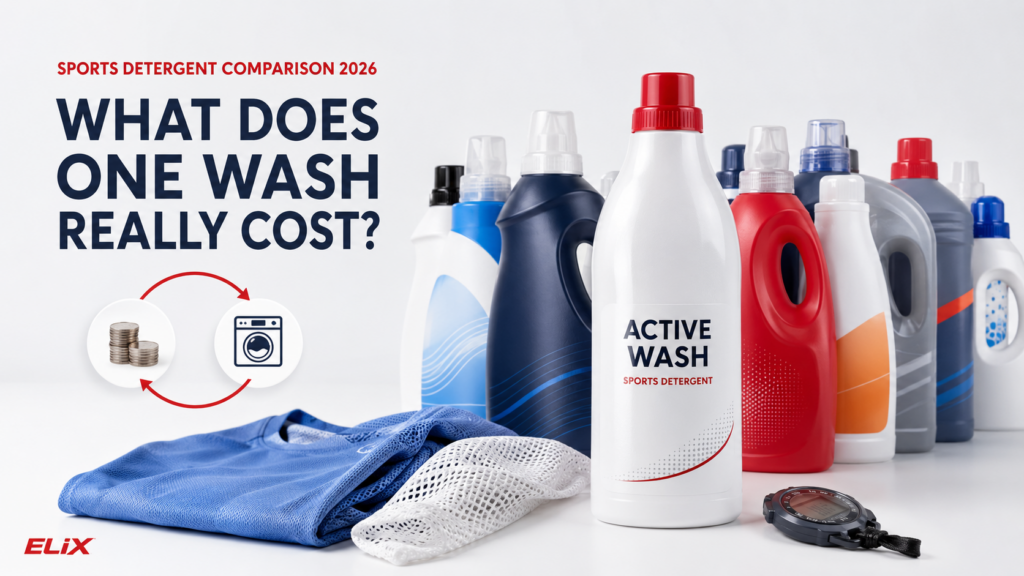
Sports Detergent Comparison 2026: what one wash really costs across 16 products
Dosage, wash temperature and membrane safety decide value in this category — not the price on the shelf. We ran the arithmetic on 16 products sold in Europe, and checked which of them a brand can actually buy as private label.
A sports detergent is judged on one thing by the person buying it: does the shirt still smell once they start sweating in it again. But the market prices itself on something else entirely — bottle size. We compared 16 sports and activewear detergents sold in Europe on the four variables that actually decide value: retail cost per wash, dosage, wash temperature and membrane safety. Cost per wash across the set ranges from €0.18 to €2.39 — a thirteenfold spread that has almost nothing to do with shelf price and almost everything to do with how much liquid the manufacturer tells you to pour in.
What we compared. Sixteen liquid detergents marketed for sportswear, activewear or technical clothing and sold in Europe, spanning three tiers: outdoor specialists, eco brands and mass-market sport variants.
Where the numbers come from. Retail prices are public German listings and manufacturer dosage instructions, collected in August 2026. Where a brand states a dosage range, we used the midpoint. Cost per wash is retail price divided by the number of standard loads the manufacturer’s own dosage allows — not the wash count printed on the front of the pack, where those two disagree.
What we did not do. We ran no laboratory tests and we report no cleaning-performance scores. Every figure here is arithmetic on published data, so anyone can reproduce it.
Disclosure. ELiX manufactures one of the sixteen products, Amarella Expert Sport with Odorano®, which appears in the table on the same basis as the rest and is discussed in a dedicated section. We have flagged it rather than buried it, because a comparison you cannot audit is worth nothing.
- Why sportswear still smells after washing
- Finding 1: dosage decides cost per wash, not shelf price
- The comparison: 16 sports detergents, cost per wash and dosage
- Finding 2: the category has a built-in contradiction
- Finding 3: wash temperature is the unsolved problem
- What “safe for membranes” actually requires
- Finding 4: almost none of this shelf can be bought as private label
- Where BRCGS certification fits — and why own-brand buyers ask about it first
- Amarella Expert Sport with Odorano® by ELiX: where it sits
- Frequently asked questions
- Sourcing a sports detergent under your own brand
Why sportswear still smells after washing
Fresh sweat is almost odourless. The culprit is sebum — triglycerides, wax esters and free fatty acids. Sebum is lipophilic, and polyester, polyamide and elastane are oleophilic, so those molecules are drawn deep inside the fibre instead of sitting on its surface. Skin bacteria then break them down into volatile odour compounds. Because the substrate sits inside the fibre, a low-temperature wash with an ordinary detergent never fully removes it, and odour accumulates load after load.
That explains why the complaint is so specific. The garment does not smell in the wardrobe; it smells once it is worn and the body warms up. Users describe it precisely — the shirt smells only after it has dried, and of mustiness rather than sweat. Or, as one parent put it:
So the functional brief for this category is narrow: remove a lipid residue from inside a synthetic fibre, at a temperature low enough not to destroy the garment, without leaving anything behind that blocks it. Everything in the table below is an attempt at that brief, at wildly different costs.
Finding 1: dosage decides cost per wash, not shelf price
The clearest example sits at the top of the market. A leading technical wash retails at €17.99 per litre, which reads as mid-priced. But its instructions call for 100–150 ml per load, so a litre delivers roughly eight washes — and one wash costs €2.25. A mass-market sport variant at €3.70–5.00 per litre asks for 50 ml, giving 20 washes per litre and a cost per wash of €0.18–0.25.
The two products are separated by about 4× on the shelf and about 10× in what they cost to use. Buyers in this category work this out for themselves, which is why forum threads about sports detergents are full of arithmetic and why one much-loved brand lost a visibly loyal following when its price per litre doubled.
Two practical consequences follow. First, small bottles in the technical tier are a value trap: a 300 ml bottle at 100–150 ml per load contains two to three washes, so a customer who buys it “to try” finds it empty almost immediately. Second, a low dose is worth more than a low price — it reduces packaging, shipping weight and product entering wastewater per wash at the same time as it reduces cost.
The comparison: 16 sports detergents, cost per wash and dosage
| Product | Pack | Retail € | Dose | Washes per pack |
Washes per litre |
Retail € per wash |
Retail € per litre |
Private label |
|---|---|---|---|---|---|---|---|---|
| Toko Eco Textile Wash | 250 ml | 11.95 | 50 ml | 5 | 20 | 2.39 | 47.80 | none found |
| Nikwax Tech Wash | 1 L | 17.99 | 100–150 ml | 8 | 8 | 2.25 | 17.99 | none found |
| Holmenkol Sport Textile Wash | 500 ml | 19.95 | 40 ml | 12.5 | 25 | 1.60 | 39.90 | none found |
| Nikwax Base Wash | 300 ml | 8.00 | 50 ml | 6 | 20 | 1.33 | 26.67 | none found |
| Grangers Performance Wash | 300 ml | 7.95 | 50 ml | 6 | 20 | 1.32 | 26.50 | none found |
| Fibertec Pro Wash Eco | 250 ml | 9.95 | 25 ml | 10 | 40 | 0.99 | 39.80 | none found |
| Hey Sport TEX WASH | 250 ml | 10.25 | 20 ml | 12.5 | 50 | 0.82 | 41.00 | none found |
| Decathlon anti-odour wash (retailer own brand) | 250 ml | 7.99 | 25 ml | 10 | 40 | 0.80 | 31.96 | retailer’s own brand |
| Nikwax Sports Refresh | 1 L | 12.74–13.90 | 50 ml | 20 | 20 | 0.64–0.70 | 12.74–13.90 | none found |
| AlmaWin Sport & Outdoor | 750 ml | 7.58 | 65 ml | 11.5 | 15.4 | 0.66 | 10.11 | not stated |
| Uni Sapon BIO Sport concentrate | 250 ml | 9.00–9.85 | 10 ml | 25 | 100 | 0.36–0.39 | 36.00–39.40 | not stated |
| Sodasan Sport & Outdoor | 750 ml | 6.49–7.49 | 35 ml | 21 | 28.6 | 0.30–0.35 | 8.65–9.99 | not stated |
| bionicdry Sport | 960 ml | 5.95 | 40 ml | 24 | 25 | 0.25 | 6.20 | none found |
| Amarella Expert Sport with Odorano® (ELiX) | 500 ml | ~12.00 | 10 ml | 50 | 100 | 0.24 | 24.00 | yes — only |
| Dr. Beckmann Quick Power Wash Sport | 800 ml | 5.99 | ~32 ml | 25 | 31 | 0.24 | 7.49 | none found |
| Perwoll Renew Sport (Henkel, mass market) | 1.35 L | 4.99–6.75 | 50 ml | 27 | 20 | 0.18–0.25 | 3.70–5.00 | brand house |
Sorted by cost per wash, the shelf separates into three bands rather than a smooth curve:
- €0.18–0.36 — mass market and eco. Perwoll, Dr. Beckmann, bionicdry, Sodasan and Uni Sapon. Doses of 32–50 ml, or in Uni Sapon’s case a genuine 10 ml concentrate.
- €0.64–0.99 — the middle. Nikwax Sports Refresh, AlmaWin, Hey Sport, Fibertec and Decathlon’s own brand. This is where dose discipline starts to appear: Hey Sport at 20 ml and Fibertec at 25 ml are the two technical brands that took concentration seriously.
- €1.32–2.39 — the technical tier. Grangers, both Nikwax washes, Holmenkol and Toko. Genuinely careful formulations aimed at membranes, sold at doses of 40–150 ml that make each wash expensive.
The interesting cases are the products that break their band. Uni Sapon proves a 10 ml dose is achievable at eco-certified quality. And the two lowest-cost-per-wash products in the whole set, at €0.24, arrive there by opposite routes: Dr. Beckmann by selling cheap liquid in volume, and a 10 ml concentrate by selling a small amount of expensive liquid.
Finding 2: the category has a built-in contradiction
We read the published ingredient declarations and safety data sheets for the four best-known membrane-safe washes here — Nikwax Tech Wash, Nikwax Base Wash, Grangers Performance Wash and Toko Eco Textile Wash. All four rely on soaps, non-ionic surfactants and chelators. None of them declares an enzyme. The same is true of the other outdoor and eco entries in the table, as far as their published declarations go. The single exception in this comparison is Amarella Expert Sport, which is enzymatic and membrane-compatible at once — and which we make, so treat that as a disclosed interest and check the specification yourself.
That is a defensible formulation choice: it is gentle and predictable. But enzymes — particularly lipase — are the mechanism that breaks down the sebum carrying the odour, rather than diluting it. Meanwhile, the products that top independent odour-removal tests tend to be enzymatic powders, and powders are explicitly excluded by membrane care guidance because undissolved particles and builder residue block a microporous structure.
So the shelf asks the customer to choose: protect the jacket, or beat the smell. Nothing about that trade-off is inevitable — a liquid can be enzymatic, and an enzymatic liquid can be softener-free, brightener-free and residue-free — but with one exception in this set, that is how the category is arranged.
Published declarations in this category include some choices a new product should think twice about: a cationic-softener-free but fragrance-heavy base with declared allergens; cyclosiloxanes D5 and D6, now restricted in detergents above 0.1% m/m; sodium pyrithione, highly toxic to aquatic organisms; formaldehyde-releasing preservatives; and isothiazolinone preservatives that make a “hypoallergenic” claim hard to defend. Benchmarking a market leader’s marketing is sensible. Benchmarking its ingredient list is not automatically so.
Finding 3: wash temperature is the unsolved problem
Ask any running or cycling community how to fix smelly kit and the answer is to wash hotter. It works — and it degrades elastane, stresses laminated membranes and shortens the life of an expensive garment. Membrane care guidance itself caps washing at around 40 °C, which puts the manufacturer’s instructions and the effective remedy in direct opposition.
This is the largest open gap in the category. Removing odour reliably at 30 °C is what the customer actually wants, because it is the only outcome that does not cost them the garment — and it saves energy on every load, which is a claim a brand can make without regulatory exposure.
What “safe for membranes” actually requires
The phrase appears on most packs in the technical tier and is rarely explained. Industry care guidance for waterproof breathable garments is consistent, and it is a short list. A detergent is compatible when it is:
- Liquid, not powder. Undissolved particles, zeolites and silicates physically block a microporous membrane.
- Free of fabric softeners. Cationic softeners bond irreversibly to the fibre and shut down the moisture transport the garment was bought for — measured data show roughly three times the wetting time versus an anionic alternative.
- Free of optical brighteners, chlorine bleach and stain removers. All three are excluded by standard care instructions.
- Dosed at roughly 30 ml per load and used at 30–40 °C on a gentle cycle with a slow spin.
- Fully rinsable. This is the most overlooked one. Soap and limescale deposits become odour carriers themselves and reduce wicking, which is why chelators matter more here than in ordinary laundry.
Note what is not on the list: neutral pH. One of the most widely recommended membrane-safe washes is a potassium soap with a declared pH of about 11, while another sits at pH 7. Membrane compatibility is a function of format and residue, not of pH.
Where pH does matter is everything else in the garment. Alkalinity is what damages elastane over repeated cycles, and it is the main reason wool must not be washed with an alkaline product. It also affects what the fabric feels like against skin after drying. So a pH near neutral is not a membrane claim — it is an elastane and skin claim, and in a category where almost every garment contains elastane, it is the more useful of the two. For reference, the values we have for products in this set span pH 7 to pH 11; Amarella Expert Sport, which we make, is buffered to pH 6.9–7.0.
An enzymatic detergent should not be used on wool, merino or silk. Protease attacks the keratin of the fibre itself, not just the soil on it, which causes fibre loss, holes and felting. Any brand selling a single “sport” SKU for both synthetic base layers and merino ones is overreaching; merino needs a separate, enzyme-free formulation.
Finding 4: almost none of this shelf can be bought as private label
This matters to a specific reader: the retailer, sports chain, gym group, e-commerce brand or distributor that has looked at the numbers above and concluded there is room for a better-value entry. The conventional route — find the product you admire and ask its maker to produce a version for you — is largely closed here. The outdoor specialists in this set are brand-led businesses that sell under their own names; the mass-market entries belong to brand houses or to retailers who are themselves private-label buyers.
We treated this cautiously in the table. “None found” means we located no public private-label offering, not that a company would refuse one; several may well produce under contract without advertising it, and anyone serious should ask them directly. But the pattern is clear enough to explain why so few own-brand sports detergents exist while own-brand universal detergents are everywhere.
Practically, a brand entering this category has three routes: commission a formula from a household-chemistry contract manufacturer that has no sports-specific experience; rebadge a generic universal gel and hope the sportswear claim survives scrutiny; or find a manufacturer that already owns a sports-specific, membrane-compatible formula. The third is rare, which is the gap this comparison exposes.
Where BRCGS certification fits — and why own-brand buyers ask about it first
If you are commissioning a detergent under your own name, the certification of the plant is not paperwork — it is the difference between a defensible product and an exposed one. The reason is legal, not commercial. Under the EU’s General Product Safety Regulation (EU) 2023/988, applicable since 13 December 2024, the party whose name and trademark appear on the product is treated as its manufacturer, with the obligations that follow: risk assessment, traceability, corrective action and recall. When you put your logo on a bottle, you inherit that role from the factory.
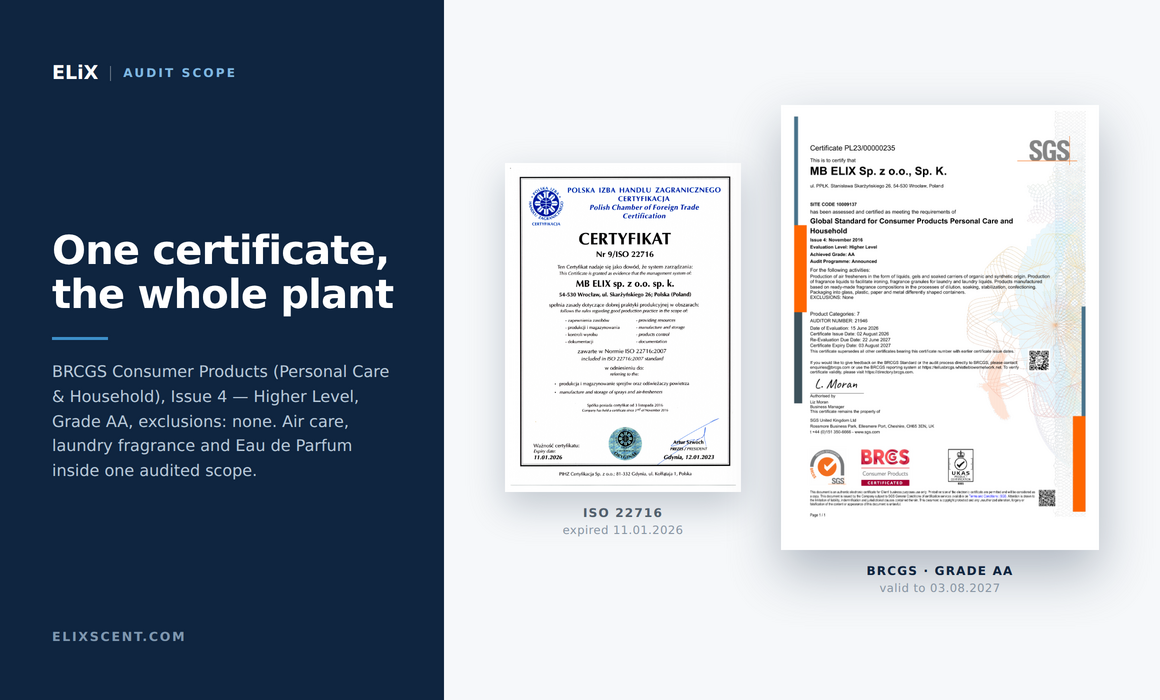
The relevant scheme for this category is the BRCGS Global Standard for Consumer Products – Personal Care and Household, currently Issue 4. BRCGS describes it as accepted and specified by “more global brand owners and retailers than any other scheme” — which is precisely the point: it exists because retailers demanded an auditable product-safety standard for the goods they sell under their own labels. Its audits cover documented risk assessment, batch traceability, raw-material and supplier control, contamination control, site hygiene, packaging control, complaint handling and product withdrawal.
Most household-chemistry plants certify to ISO 9001 and ISO 14001, which are management-system standards — they say the factory manages quality and environment consistently. They are not product-safety audits and they are not what a retail buyer’s compliance team is looking for. A BRCGS Consumer Products or IFS HPC certificate is a different class of assurance, and materially fewer contract manufacturers in this category hold one.
So ask for three things in writing before you commit: the certificate itself, with scope and grade; the public directory entry so you can verify it independently rather than take a PDF on trust; and the documentation pack the plant supplies as standard — safety data sheet, UFI code, REACH / CLP classification and IFRA statements. A manufacturer that produces all three without hesitation has done this before. One that offers a logo on a website instead has not.
The practical exposure of getting this wrong is concrete: a retail buyer’s audit that stops the listing, a marketplace compliance check that delists the product, a product-liability insurer that declines cover, and — in the worst case — a recall you have to fund and administer as the legal manufacturer of a product you did not make.
Amarella Expert Sport with Odorano®: where the ELiX product sits in this comparison
ELiX builds detergents for other companies’ brands, and this comparison is the reasoning behind the one we make for this category. Amarella Expert Sport with Odorano® — part of the Amarella laundry care range — is an ultra-concentrated enzymatic sports laundry gel, specified directly against the four findings above. It is the row highlighted in the table, and the one product in the set that is both membrane-compatible and enzymatic.
30 °C, not 60 °C
A multi-enzyme complex tuned for low-temperature performance, so odour is removed without the hot cycle that damages elastane and membranes. Addresses Finding 3.
Odorano®
ELiX’s own odour-neutralising technology. It acts during the wash on the sebum residue that carries sweat odour, rather than covering it with fragrance. Light citrus scent, deliberately restrained.
Membrane-safe and enzymatic
Liquid concentrate, no fabric softeners, no optical brighteners, no chlorine bleach, no zeolites or silicates — while still enzymatic. Addresses Finding 2.
pH 6.9–7.0
Buffered to neutral, against a market spanning pH 7 to pH 11. Alkalinity is what degrades elastane over repeated washes — and almost every sports garment contains it.
10 ml per load
50 washes from 500 ml, 100 per litre. At a recommended retail price of about €12, that is €0.24 per wash — level with supermarket sport variants. Addresses Finding 1.
Two further properties matter more to brand owners than to end users. The formula is hypoallergenic and dermatologically tested, which is what makes it defensible for children’s kit — the largest volume pocket in this category. And it is produced in our BRCGS-certified facility in Poland, with SDS, UFI, REACH / CLP and IFRA supplied as standard.
Because ELiX develops, owns and manufactures Odorano® rather than licensing it in, there is no royalty in the cost price, no external approval loop when a formula needs adjusting, and category or territory exclusivity can be discussed directly with the owner of the technology.
| Product | Amarella Expert Sport Laundry Gel with Odorano® |
|---|---|
| Wash temperature | Effective from 30 °C |
| Odour technology | Odorano® — developed, owned and manufactured by ELiX |
| Fabric protection | Safe for waterproof breathable membranes; no softeners, optical brighteners or chlorine bleach |
| Cleaning system | Multi-enzyme complex tuned for low-temperature performance |
| pH | 6.9 – 7.0 (neutral, buffered) — protects elastane and reduces skin contact irritation |
| Skin | Hypoallergenic · dermatologically tested |
| Scent | Light citrus (alternative profiles available from the Amarella range) |
| Reference format | 500 ml ultra-concentrate — pack size configurable |
| Dose | 10 ml per standard load (4–5 kg) |
| Washes | 50 per 500 ml · 100 per litre |
| Recommended retail price | ~€12 per 500 ml, set by the brand owner |
| Retail cost per wash | ~€0.24 |
| Fabrics | Synthetics, elastane blends, cotton, garments with waterproof breathable membranes. Not for wool or silk |
| Other | No microplastics |
| Production | Poland · BRCGS-certified facility |
| Documentation | SDS · UFI · REACH / CLP · IFRA |
| Availability | Private-label projects only — pack size, dose, declared wash count, scent and price architecture defined with the brand owner |
Frequently asked questions
Which sports detergent has the lowest cost per wash?
In this comparison, Perwoll Renew Sport at €0.18–0.25 per wash, followed by Dr. Beckmann Quick Power Wash Sport and Amarella Expert Sport at €0.24 and bionicdry at €0.25. The most expensive per wash is Toko Eco Textile Wash at €2.39, then Nikwax Tech Wash at €2.25 — both because of high recommended dosage rather than a high shelf price.
Is an expensive technical wash worth it?
It depends on what you are washing. For garments with waterproof breathable membranes, a formulation without softeners, brighteners or bleach genuinely protects an expensive item, and if you wash a shell jacket three times a year the cost per wash is irrelevant. For base layers and gym kit washed five times a week, cost per wash dominates and a concentrate is far better value.
What detergent is safe for GORE-TEX and other membranes?
Any liquid detergent without fabric softeners, optical brighteners, chlorine bleach or stain removers, dosed at around 30 ml and used at 30–40 °C on a gentle cycle. Powders should be avoided because undissolved particles and builders block the microporous structure. GORE-TEX® is a registered trademark of W. L. Gore & Associates; nothing here implies endorsement or certification by any membrane manufacturer.
Why do my workout clothes smell even after washing?
Because the odour source is sebum absorbed inside the fibre, not sweat on its surface. Synthetic fibres are oleophilic and hold those lipids tightly, so a cool wash with an ordinary detergent leaves them behind and bacteria keep converting them into volatile odour compounds. Enzymes, particularly lipase, target that residue; fabric softener makes it worse by coating the fibre.
Can sportswear be washed effectively at 30 °C?
Yes, but it requires a detergent designed for it. Higher temperatures remove odour more easily, which is why 60 °C is such common advice — but they also degrade elastane and stress laminated membranes, and membrane care guidance caps washing at around 40 °C. A detergent with enzymes tuned for low-temperature performance is what closes that gap.
Should I use fabric softener on sportswear?
No. Cationic softeners bond to the fibre and block the moisture transport the garment was bought for; measured data show around three times the wetting time compared with an anionic alternative. They are also one of the most common reasons odour returns, because the coating holds residues.
What pH should a sports detergent have?
Close to neutral, roughly pH 6.5–7.5 — but not for the reason usually given. Membrane compatibility does not depend on pH: one of the most recommended membrane-safe washes is a potassium soap at about pH 11. What pH governs is the rest of the garment. Alkalinity degrades elastane over repeated cycles, damages wool, and leaves fabric harsher against the skin. Since almost every sports garment contains elastane, a neutral product is the safer choice for garment life. Values across the products in this comparison span pH 7 to pH 11; Amarella Expert Sport with Odorano®, manufactured by ELiX, is buffered to pH 6.9–7.0.
Are enzymatic detergents safe for merino wool?
No. Protease attacks keratin, which is the wool fibre itself, causing fibre loss, holes and felting. Wool and silk need a dedicated enzyme-free formulation, separate from any enzymatic sports detergent.
Which sports detergents are available as private label?
Very few. Of the 16 products compared here we found no public private-label or contract-manufacturing offer for 10, three do not state a position, one is a retailer’s own brand and one belongs to a brand house that does not supply third parties. Amarella Expert Sport with Odorano®, made by ELiX, is offered as a private-label project only. Companies marked “none found” may still produce under contract without advertising it — ask them directly.
What should I check before commissioning an own-brand detergent?
Three things in writing: the plant’s certificate with its scope and grade — BRCGS Consumer Products or IFS HPC rather than ISO 9001 alone, which is a management-system standard and not a product-safety audit; the public directory entry so you can verify it independently; and the standard documentation pack, meaning safety data sheet, UFI code, REACH / CLP classification and IFRA statements. Under GPSR (EU) 2023/988 the brand on the bottle is the legal manufacturer, so this is your exposure, not the factory’s.
ELiX manufactures Amarella Expert Sport with Odorano® exclusively as a private-label and distribution programme for EU markets. If the numbers in this comparison have identified a gap in your range, we can model the specification against the shelf price you are targeting.
- Samples for evaluation, including wash trials on your own garment types
- Pack size, dose and declared wash count defined together with you
- Retail price architecture modelled to your target shelf price
- Artwork support and multilingual labelling for EN, DE, PL, RO, FR and ES
- Documentation pack as standard: SDS, UFI, REACH / CLP, IFRA
- Production in our BRCGS-certified facility in Poland
Tell us the market, the shelf price you are targeting and the wash count you want on the front of the bottle — we will build the specification around it.
Request samples and a quotation →* “1 membrane-safe and enzymatic” means that of the 16 products compared, one — Amarella Expert Sport with Odorano®, made by ELiX — combines a declared enzyme system with a membrane-compatible specification. The four best-known membrane-safe washes here, whose full published ingredient declarations and safety data sheets we reviewed, declare no enzyme: Nikwax Tech Wash, Nikwax Base Wash, Grangers Performance Wash Concentrate and Toko Eco Textile Wash. Mass-market sport variants such as Perwoll Renew Sport do declare enzymes but are not positioned or sold as technical membrane washes. This is a statement about published declarations for the products examined, not about any product we did not examine.
Amarella® and Odorano® are trademarks of ELiX. GORE-TEX® is a registered trademark of W. L. Gore & Associates; references to membrane compatibility describe suitability for garments with waterproof breathable membranes and do not imply endorsement or certification by any membrane manufacturer. All other brand names are the trademarks of their respective owners and are used here for identification and comparison only. All prices quoted are retail (consumer) prices collected from public German listings and manufacturer dosage instructions in August 2026 and are subject to change; readers should verify current prices and dosage before relying on them. Cost per wash is calculated arithmetically from those figures and is not a measure of cleaning performance — this article reports no laboratory testing. Private-label availability reflects publicly available information at the time of writing; “none found” means no public offering was located and should not be read as a refusal. ELiX manufactures Amarella Expert Sport with Odorano®, one of the products compared. Not suitable for wool or silk.