Sourcing · Landed cost
Is It Still Cheaper to Import Air Fresheners From China in 2026?
For most of the last twenty years the answer was obviously yes. In August 2026 it depends entirely on whether you compare factory prices or landed cost — and the gap between those two numbers has never been wider. Here is the arithmetic, with the assumptions written down so you can check it against your own.
The short answer
On ex-works price, a Chinese supplier will almost always quote below a Polish one. That has not changed.
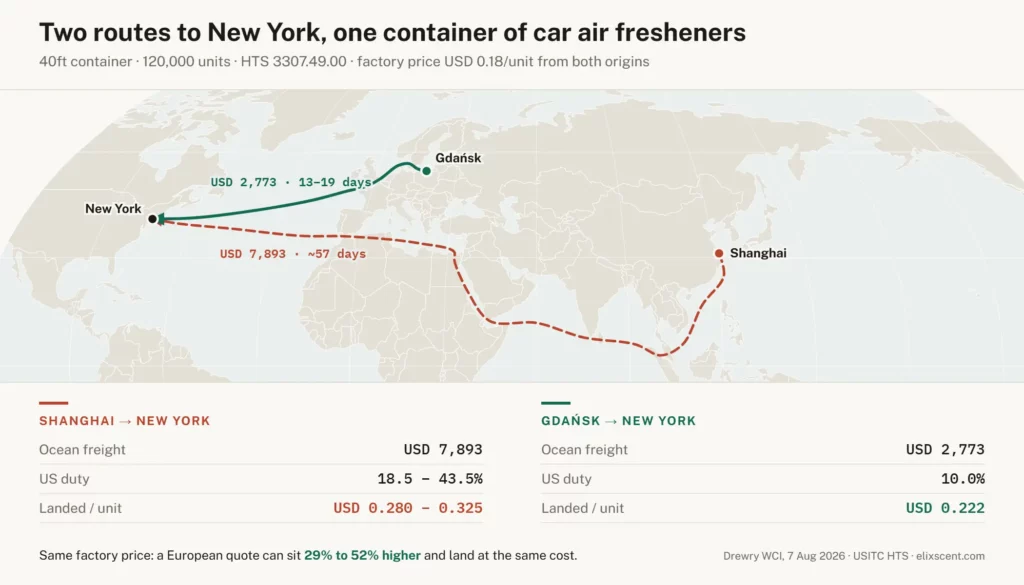
On landed cost — the number your finance team actually pays — the picture in August 2026 is different. Air fresheners from the EU carry a total duty of 10%. From China the verified floor is 18.5%, and depending on legacy Section 301 list membership it can reach 43.5%. Ocean freight from North Europe to the US East Coast is running at roughly one third of the Shanghai rate.
Put together, a European manufacturer can be priced roughly 29% to 52% above the Chinese factory price and still deliver the same cost to your door. Whether that covers the real gap on your specific SKU is a question only your own numbers can answer — which is the entire point of this article.
First, the definition most quotes get wrong
Factory price is what a supplier charges you at their gate. Landed cost is factory price plus duty, plus freight, plus fees, plus the working capital you tie up getting the goods to your warehouse. Two suppliers can differ by 40% on the first number and be identical on the second.
- Ex-works / FOB price
- What the factory charges. The only number most sourcing conversations ever get to.
- Landed cost
- Factory price + customs duty + Merchandise Processing Fee + Harbor Maintenance Fee + ocean freight + terminal handling + customs brokerage + drayage + insurance, divided by the units that actually arrive saleable.
- Cost of ownership
- Landed cost plus the money you cannot see on any invoice: the deposit you financed for two months, the safety stock a longer pipeline forces you to carry, the rework on an off-spec batch, and the recall you hope never happens.
- MOQ vs price-break threshold
- Not the same thing. A minimum order quantity is a hard floor below which a supplier will not produce. A price-break threshold is the volume at which the unit price drops. Suppliers frequently present the second as the first.
What is the duty on air fresheners from China in 2026?
As of 24 July 2026, the verified minimum total duty on Chinese-origin air fresheners under HTS 3307.49.00 is 18.5% — 6% MFN plus the new 12.5% Section 301 forced-labour duty. Legacy Section 301 list duties stack on top of that, which can take the total to 43.5%. EU-origin goods in the same heading pay a flat 10%.
US tariff architecture changed twice this year, and a lot of sourcing decks have not caught up. Two dates matter:
- 20 February 2026 — the Supreme Court held in Learning Resources, Inc. v. Trump that IEEPA does not confer tariff authority. Collection of all IEEPA tariffs stopped on 24 February. The “fentanyl» and “reciprocal» layers you may still see quoted are gone.
- 24 July 2026 — a new Section 301 action took effect (Federal Register notice 2026-15181), covering roughly 60 economies through HTS subheadings 9903.05.20 to 9903.05.84.
The mechanism differs by origin, and the difference is the whole story. For China, the new duty is 12.5% added on top of MFN and on top of any pre-existing Section 301 list duty. For the European Union it is a ceiling, not an addition — the notice states that “the sum of the MFN tariff and the section 301 tariff shall be 10 percent.»
| HTS heading | Product | MFN | From Poland / EU | From China (floor) | From China (if legacy List 3) |
|---|---|---|---|---|---|
| 3307.49.00 | Car & home air fresheners | 6% | 10.0% | 18.5% | 43.5% |
| 3307.90.00 | Other perfumery preparations | 5.4% | 10.0% | 17.9% | 42.9% |
| 3402.50.51 | Retail laundry preparations | Free | 10.0% | 12.5% | — |
| 3402.90.50 | Other washing preparations | 3.7% | 10.0% | 16.2% | 41.2% |
| 3303.00.30 | Eau de Parfum (alcohol-based) | Free | 10.0% | 12.5% | 20.0% |
| 3301.90.50 | Essential oils | Free | 10.0% | 12.5% | — |
Rates from the USITC Harmonized Tariff Schedule, retrieved 10 August 2026, combined with Federal Register notice 2026-15181. Classification of hanging and vent-clip car air fresheners under 3307.49.0000 is settled by CBP ruling NY N231826.
We could not resolve one variable from public sources, and we would rather say so than round it in our own favour. The annexes that determine which legacy Section 301 list Chapter 33 goods sit on are published in the Federal Register only as scanned images, and no commercial tracker maps them at 8-digit level. That is a 25-percentage-point swing.
Your broker can settle it in thirty seconds. Ask them to pull the Chapter 99 flag from your last entry summary in ACE for HTS 3307.49.00. Whatever number comes back, put it in the table above and re-run the comparison. If it comes back at 18.5%, our case is weaker than the headline. We would still rather you had the real figure.
What does ocean freight actually cost right now?
On Drewry»s World Container Index assessed 7 August 2026, Shanghai to New York was USD 7,893 per 40ft container. Rotterdam to New York was USD 2,773. That is a difference of USD 5,120 per box — and on a high-cube of light, bulky product it is a larger line item than most buyers expect.
| Lane | USD / 40ft | Indicative transit |
|---|---|---|
| Shanghai → New York | 7,893 | ~57 days |
| Shanghai → Los Angeles | 5,894 | ~36 days |
| North Europe → New York | 2,773 | 13–19 days |
Drewry World Container Index, assessment date 7 August 2026. Transit figures: Flexport Ocean Timeliness Indicator (measured end-to-end, week to 27 July 2026) for the Asia lanes; carrier schedules for Gdańsk–US East Coast, including MSC»s direct weekly Gdańsk–Bremerhaven–New York–Charleston service.
Air fresheners cube out long before they weigh out. Carded hanging fresheners, gel cans, vent clips and reed diffuser sets are light and bulky, which means freight is a real proportion of landed cost rather than a rounding error. In the worked example below, ocean freight alone accounts for USD 0.066 per unit from China against USD 0.023 from Poland.
Transit time matters less than most sourcing articles suggest — if your forecasting is good, a long pipeline is a planning problem rather than a cost problem. Worth noting only that flammable fragrance goods are effectively ocean-only at commercial volume, so you cannot air-freight your way out of a stockout from either origin. Freight cost, on the other hand, hits every single container.
A worked example: one 40ft container of car air fresheners
Below is a complete line-by-line landed cost for the same container from both origins, at an identical factory price, so the comparison isolates the trade cost. Every assumption is stated. Substitute your own and the structure still holds.
Carded paper hanging car air freshener, HTS 3307.49.0000. 120,000 units in a 40ft high cube — deliberately conservative for this format. Factory price USD 0.18 per unit from both origins, so the comparison measures trade cost and nothing else. Customs value on transaction value; international freight is not dutiable under 19 U.S.C. §1401a. MPF at 0.3464%, capped at USD 651.50 per formal entry for FY2026. HMF 0.125%. Freight per Drewry, 7 August 2026. Terminal handling, brokerage, drayage and insurance excluded from both sides as broadly symmetrical.
| Cost line | China (legacy List 3) | China (verified floor) | Poland |
|---|---|---|---|
| Goods value at factory | 21,600 | 21,600 | 21,600 |
| Customs duty | 9,396 | 3,996 | 2,160 |
| MPF + HMF | 102 | 102 | 102 |
| Ocean freight | 7,893 | 7,893 | 2,773 |
| Total landed (USD) | 38,991 | 33,591 | 26,635 |
| Landed per unit (USD) | 0.325 | 0.280 | 0.222 |
The number that actually decides the question
Nobody buys from Poland at a Chinese factory price. So the useful question is not “who is cheaper» but how much more can a European manufacturer charge at the factory gate before your landed cost goes up?
| If your China duty is… | China landed / unit | Break-even EU factory price | Premium the EU can carry |
|---|---|---|---|
| 43.5% (legacy List 3 applies) | 0.325 | 0.273 | +51.8% |
| 26.0% (legacy List 4A applies) | 0.298 | 0.249 | +38.2% |
| 18.5% (verified floor, no legacy list) | 0.280 | 0.233 | +29.2% |
So: somewhere between 29% and 52%. The 29% figure survives even if every unresolved question resolves against us. If your European quote is inside that band, you are not paying a premium — you are paying the same money to a different address. If it is outside, China is genuinely cheaper on your SKU and you should say so.
Where China is still cheaper — honestly
There are cases where a Chinese supplier is the right commercial answer in 2026, and an article that pretends otherwise is not worth reading. Four of them are real.
- Packaging componentry and tooling iteration. Component suppliers within a two-hour drive of each other, mould makers who have already built every variation of the part you want, prototype Monday and samples Friday. If your project is a new cap, bottle, clip or dispenser geometry, no European supply base matches that density or that speed. We do not pretend to.
- Very low unit price at commodity specification. At the opening price point, on a standard format, with no compliance sophistication required, a Chinese factory will usually win on unit cost and often on flexibility for a first small run.
- Mexico, not China, is your real price benchmark in this category. Mexico accounts for roughly 62% of US imports under HTS 330749 — mass aerosol and plug-in production under USMCA, duty-free and nearshore. Chinese origin is around 14% and falling. If your comparison set is Mexican-made mass aerosol, no European supplier is going to beat it on landed cost, and you should not let anyone tell you otherwise.
- Diversification has carrying costs. Running two origins means inventory in two places, two sets of documentation, two audit relationships. That is real overhead, and it should be counted.
The honest version of the European case is not “we are cheaper» and not “Asia is bad». It is narrower and more useful: at the same landed cost, you get a supplier operating under a documentation regime you can hand straight to your compliance team, in a jurisdiction where your lawyer can act, close enough that you can walk the plant. If landed cost is not the same, that argument does not apply and we would rather find out early.
The costs that never appear on the invoice
In every documented US enforcement action in this category, the cost landed on the US importer, brand owner or retailer — not on the offshore manufacturer. That is not a moral point. It is a structural one about who is reachable by a US regulator.
The clearest illustration is recent. In December 2025 the CPSC found a wintergreen essential oil sold on Amazon since 2022 without child-resistant packaging — a mandatory standard, because wintergreen oil is around 98% methyl salicylate. The manufacturer is a Chinese supply-chain company. CPSC issued a Notice of Violation, the manufacturer did not agree to recall or remedy, and so the agency could only publish a consumer warning. The seller of record and the marketplace absorbed the consequence: the inventory, the listing, and the liability.
Other documented outcomes, all borne by the US party:
| Case | What happened | Cost to the US party |
|---|---|---|
| TJX Companies (CARB) | Air fresheners and other consumer products imported over California VOC limits | USD 196,800 |
| OnTel Products (EPA / FIFRA) | Imported product carrying antimicrobial claims without EPA registration | USD 638,624 |
| Pura Scents (CPSC) | 851,400 diffusers recalled, magnet ingestion hazard. US brand, China-origin hardware | Full recall cost |
| Walmart private label (CPSC / CDC) | 3,900 bottles of aromatherapy room spray, made offshore, contaminated with Burkholderia pseudomallei. Two deaths, four melioidosis cases | Recall + litigation |
| Repeat Prop 65 defendants | Lead in the decorated exterior of ceramic and glass diffusers and warmers. One settled 2025 case: USD 3,000 penalty, USD 25,500 plaintiff»s legal fees | ~USD 28,500 per notice |
A finding that will surprise you about Proposition 65
We queried the California Attorney General»s 60-day notice database for this category expecting the fragrance to be the exposure. It is not. The overwhelming majority of home-fragrance Prop 65 notices target lead in the decorated ceramic or glass vessel — not the oil inside it. Eight of eleven “diffuser» notices, and the recent “air freshener» notices, are lead-in-decoration cases.
The practical consequence: being phthalate-free — which we are — addresses the DEHP and DINP exposure but says nothing about lead in a printed bottle. If you are sourcing decorated glass or ceramic, ask for surface lead test data to the 90 ppm standard that Prop 65 settlements in this category actually use, whoever your supplier is. It is a cheap certificate and an expensive omission.
Two dates already in the calendar
CPSC mandatory eFiling of Certificates of Compliance took effect. Importers must submit certificate data electronically before regulated product enters US commerce. Foreign Trade Zone entries follow on 8 January 2027. CPSC states it “does not apply to domestic manufacturers» and “creates no new testing, certification, or compliance obligations» — it makes the existing ones machine-readable and therefore targetable. If your supplier cannot hand you structured certificate data at PO stage, that is now friction at the border rather than paperwork you can chase later.
California»s VOC limit for manual aerosol air fresheners drops from 10% to 5%. Concentrated aerosol drops from 15% to 10%. Any formula currently built to the 10% limit is obsolete for product manufactured from that date. Formulate to CARB and you clear the OTC states as well; formulate to OTC and you fail California. Separately, from 1 January 2031 the fragrance exemption in the CARB calculation falls from 2% by weight to 0.25% for air fresheners — at which point holding a real top-heart-base structure in a compliant Californian air freshener becomes a question of shifting the accord toward LVP-VOC materials. That is a perfumery capability, not a procurement decision.
What about the other four categories?
Laundry fragrance
US fabric care is currently being won on scent, not on cleaning performance. Two of the top five non-food new-product Pacesetters of 2025, as measured by Circana, were laundry fragrance propositions — a scent booster and a mood-named in-wash fragrance. That is a perfumery brief.
Meanwhile private-label liquid detergent grew 19% the last time Circana published the figure, and US private label overall reached a record 23.5% unit share and USD 282.8 billion in 2025 while national brands grew 1.2%. A branded number-three player now names private-label shelf gain as a risk factor in its annual report. The opening is not subtle.
Odour neutralisers — and a claim we deliberately do not make
Odorano neutralises odour molecules. We make no antimicrobial, sanitising or “kills odour-causing bacteria» claim, and that is a compliance decision rather than a marketing omission.
EPA»s line is precise. A product that “prevents, blocks, neutralizes, reduces, eliminates, encapsulates or removes odors» is not a pesticide. A product that claims to control “bacteria or other pests that cause odors» is a pesticide requiring FIFRA registration — and the liability attaches to whoever distributes or sells it in the United States. A great many imported “odour killer» listings sit on the wrong side of that line, often because a claim was added downstream by a marketplace seller the manufacturer never spoke to. OnTel paid USD 638,624 for exactly that shape of problem.
For distributors and private-label buyers, the practical value is that our claim architecture is built to stay inside the non-pesticidal definition, and we will not agree to marketing copy that steps outside it. TACTICLEAN, our scent-free concentrate, is designed for exactly the case where you want to add your own fragrance and your own name — and it is a natural fit for janitorial and sanitation distribution, which buys on cost-in-use, dilution ratio and dispenser compatibility rather than on brand.
Eau de Parfum
Fine fragrance is the one category where European origin is already the market»s default expectation rather than a premium to be justified. France alone accounts for around 54% of the USD 4.49 billion of perfume imported into the United States; Spain and Italy add a further 28%. Chinese origin is under 1%.
HIKARI is our Eau de Parfum line, developed by the same perfumers and the same lab — AFL, Aroma Formulation Labs — that formulate our air care. Designer-inspired, never presented as a copy of a named perfume. Entry volumes start from around 200 units per SKU, with CPNP notification, a Product Information File and a Cosmetic Product Safety Report behind each formula.
Professional diffusion and essential oils — read this if you buy scent-marketing oil
If you buy oil for cold-air, HVAC, reed or ultrasonic diffusion in the United States, you are most likely buying it from the company that sold you the hardware. We only make the oil. That is the entire difference, and it is worth about an order of magnitude per litre at the top of the range.
Professional diffusion oil in the US market is priced in a way that makes comparison difficult on purpose. Some suppliers list sizes without rendering per-size prices until you click each variant; others quote only against a service agreement whose price is explicitly a function of contract length. Here is what is actually published, converted to a common unit:
| Format | What you buy | Published price | Per litre |
|---|---|---|---|
| 30 ml proprietary pod | Device-specific cartridge | USD 54.95 | ~USD 1,832 |
| 50–60 ml bottle | Open bottle | USD 39.99–69.00 | ~USD 800–1,150 |
| 100–150 ml bottle | Open bottle | USD 42.99–59.99 | ~USD 400–430 |
| 500 ml bottle | Open bottle | USD 109.99–129.99 | ~USD 220–260 |
| 1 litre bottle | Open bottle | USD 199.99 | ~USD 200 |
| Managed cartridge programme | Sealed cartridge, volume not disclosed | Quote only | Not computable |
Compiled from published US supplier product pages, 10 August 2026. Where a supplier publishes no fragrance price at any volume — as the two largest managed-service operators do not — we have written “quote only» rather than estimate. The 500 ml figure includes one price observed on a third-party marketplace listing rather than the brand»s own site.
Three things follow, and none of them require anyone to be criticised:
- The transparent floor is around USD 200 per litre, and every step down in bottle size multiplies it — up to roughly nine times, in the proprietary pod format. If you are on a pod or cartridge programme, your effective cost per litre is probably not a number you have ever seen written down.
- Hardware and oil are frequently coupled by warranty. One major operator»s own FAQ states that its diffusers are designed to work with its own oils and that using another brand voids the warranty. That is a legitimate engineering position. It is also a switching cost, and it belongs in your cost of ownership.
- The oil is often not made by the company selling it. One of the largest commercial scenting operators publicly credits its collaboration with a global fragrance house as what “sets us apart». That is the tier we operate in — we formulate in our own lab, and we sell the compound rather than the subscription.
Compatibility is the part nobody writes about
Three diffusion technologies impose three genuinely different physical requirements, and a supplier who treats them as one product is telling you something.
- Cold-air / nebulising needs neat oil inside a viscosity window — thin enough to atomise to a 1–10 micron dry mist, not so thin it flashes off before it disperses. No water, no alcohol, no carrier oil: carrier oils film the atomiser and eventually block it. Heavy resinous bases at full strength are too viscous for most units, which is a real constraint on how you build the base of the accord.
- Ultrasonic needs the opposite: a water-dispersible system, because aroma materials are hydrophobic and neat oil can foul the piezo plate. That means a solubiliser selected by HLB for the material set — not the same product as the cold-air oil.
- Reed needs a carrier solvent chosen as a trade-off between throw and reed life, where too thick a solvent pools instead of wicking and too volatile a one shortens the life and creates a flammability classification you have to declare.
We formulate each of the three deliberately, and we will tell you which of your existing hardware a given oil suits before you buy it. We do not sell the hardware, so we have no reason to steer you.
Who owns your formula, and where are your moulds?
This is not a question about honesty. It is a question about default ownership. Ownership tends to sit with whoever holds the physical asset and whoever filed first — and most small and mid-sized brands never paper either.
China operates a first-to-file trademark system. Whoever registers your mark there owns it there, regardless of who created it or first used it elsewhere. A US registration confers nothing. Chinese customs will act on the local registrant»s complaint against the legitimate owner»s outbound shipment; there are documented cases of companies buying their own trademark back for six figures.
Tooling follows the same logic. Practitioner reporting in this area documents mould retrieval costing USD 200,000 on tooling originally bought for USD 80,000; a factory holding five moulds across three product lines with a two-month shutdown costing around USD 800,000 in lost revenue; and a per-unit surcharge substituted for a tooling invoice that accumulated to roughly USD 850,000 over fifteen years before anyone noticed. The warning signs are consistent: a supplier reluctant to physically label moulds with your name, a contract that says “tooling provided by supplier», an offer to keep the moulds “for safekeeping», no itemised tooling inventory.
Under our private-label model, a custom formula developed for you is yours, assigned in writing, in a jurisdiction where your own counsel can act. We keep our patented formulations — Odorano and Relaxeen — and you keep yours. Both halves of that sentence matter.
What we are not going to claim
We would rather lose an argument than win one on a claim that does not survive checking. Six things we will not tell you, because they are either unverifiable or untrue.
- That sourcing is moving to Europe. It is not, in aggregate. Kearney»s 2026 Reshoring Index remains negative. China lost roughly USD 135 billion of direct US import volume and fell below 10% of US manufacturing imports — but the other Asian low-cost countries gained USD 193–194 billion between them, and Mexico gained 8%. North American nearshoring moved from 7.1% to 7.6% of sourcing. The China exit is real; Europe is not where most of it went.
- That European manufacturing has a measurably lower defect rate. That comparison is not in the public record. We are not going to invent it.
- That “Made in Europe» carries a quantified fragrance premium with US consumers. We looked for a credible primary survey and did not find one.
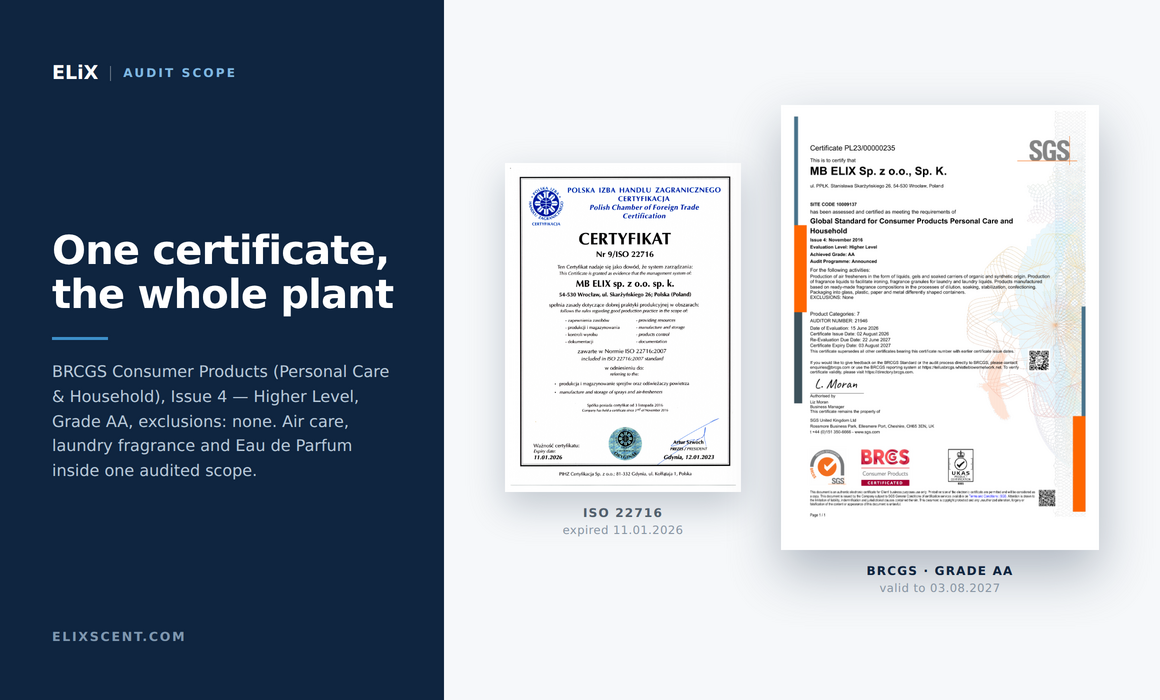
- That our certifications are a US legal requirement. Our BRCGS Consumer Products certificate — grade AA, PL23/00000235, issued by SGS UK under UKAS accreditation — is an independently audited quality credential. It is not a US regulatory requirement, and GFSI recognition applies to food safety schemes only, not to this one.
- That EU documentation discharges US obligations. It does not, and anyone who tells you otherwise will cost you money. REACH registration has no US equivalent — every raw material still has to clear the TSCA Inventory. An EU safety data sheet is structurally compatible with OSHA HazCom but must be re-issued with US classifications, US exposure limits and a US emergency contact. CLP hazard statements are not FHSA signal words; the artwork has to be re-authored rather than translated. CPNP notification carries no US recognition; FDA facility registration and product listing under MoCRA are separate filings. IFRA conformity is evidence, not compliance — and since the 52nd Amendment consultation only closed in June 2026 with formal notification expected around November, nobody can honestly claim conformity to it yet.
- That our products are hypoallergenic. We see that word used freely in this market with no standard named. We will tell you which allergens are declared at which threshold, and give you the IFRA and CLP documentation to verify it.
What we will say is specific and checkable: 1,000+ tested fragrance profiles; phthalate-free; formulated to IFRA 51st Amendment; REACH and CLP compliant with UFI/PCN and SDS packs supplied as standard; BRCGS Consumer Products grade AA; ISO 9001 and ISO 14001; EU production in Wrocław, Poland, since 1999; wholesale of our own brands with no fixed per-SKU minimum at around 28 days; private label with a price-break threshold around 3,000 units per SKU rather than a hard floor; Eau de Parfum from around 200 units.
We are looking for a US manufacturing partner
One part of our strategy is not yet in place, and we would rather say so publicly than pretend the picture is finished. We intend to produce locally in the United States with a partner who already has market and sales there. We have not found that partner yet.
What we would bring is the formulation side: a perfumery lab, 1,000+ tested profiles across five product categories, and compositions developed and compounded in the US for the US market. What we are looking for is the other half — an established distribution position in the automotive aftermarket, car-wash chemistry, janitorial and sanitation supply, or private-label household goods, held by a company that would rather own fragrance capability than buy it in.
If that describes you, the conversation is worth having whether or not you ever buy a container from Poland. Interestingly, we could find no evidence that any European air-care manufacturer has localised production in the United States. The large fragrance houses compound here, but they sell compound to brands rather than finished air care. Whether that position is unoccupied because it is valuable or because it is uneconomic is exactly what we would want to test with a partner rather than alone.
How to check all of this yourself, in one afternoon
- Ask your broker for the Chapter 99 flag on your last entry under HTS 3307.49.00 — or whichever heading applies to your product. That gives you your real China duty rate rather than our estimate.
- Pull your last three ocean invoices and calculate freight per saleable unit, not per container. Most buyers have never seen this number.
- Add your deposit financing. Take your typical deposit percentage, multiply by the days between payment and goods-available, and apply your cost of capital. Then add the safety stock your pipeline length forces you to hold.
- Total those three and divide by units. That is your landed cost. Compare it to a European quote — not to a European factory price.
- Then ask for one European quote on one SKU and put it into the same model. Would it be unreasonable to run a single SKU as a parallel source before your next reorder, just to see where the number lands?
Frequently asked questions
How much is the tariff on air fresheners from China in 2026?
As of 24 July 2026, the verified minimum is 18.5% under HTS 3307.49.00 — 6% MFN duty plus the new 12.5% Section 301 forced-labour duty. Legacy Section 301 list duties of 7.5% or 25% stack on top where they apply, which takes the total to 26% or 43.5%. EU-origin goods in the same heading pay a flat 10%, because the Section 301 duty for the EU operates as a ceiling net of MFN rather than as an addition. Confirm your own rate with your customs broker against your entry data.
What is the HTS code for car and home air fresheners?
3307.49.00.00 — “preparations for perfuming or deodorizing rooms, other». CBP ruling NY N231826 confirms that fragrance-impregnated paper, PVC and EVA hanging and vent-clip car air fresheners classify here regardless of shape or mounting method. MFN duty is 6%.
Did the de minimis exemption really end?
Yes. It was suspended for China and Hong Kong on 2 May 2025 and globally on 29 August 2025, reaffirmed by executive order on 21 February 2026, and CBP published proposed rules on 23 June 2026 to suspend it indefinitely under the Tariff Act of 1930 rather than emergency powers. Statutory repeal for commercial shipments takes effect in July 2027. Every shipment now requires a formal or informal entry with 10-digit classification and payment of applicable duties, whatever its value.
What is the minimum order quantity for private label air fresheners?
Ours is not a hard floor. Around 3,000 units per SKU is where the price break sits, and we will discuss below it. Eau de Parfum starts from around 200 units. White label runs 8–12 weeks; wholesale of our own brands runs around 28 days with no fixed per-SKU minimum. Be careful with suppliers who present a price-break threshold as a minimum — they are different things.
Does an EU safety data sheet work in the United States?
Structurally yes, substantively no. OSHA HazCom uses the same 16-section GHS format, so most content transfers — but the sheet must be re-issued with OSHA HazCom classifications rather than CLP, US occupational exposure limits, a US emergency contact and US supplier identity. Under HCS 2024, which aligns to GHS Revision 7, the deadline for substances passed on 19 May 2026 and the mixtures deadline is 19 November 2027. Separately, REACH registration does not substitute for the TSCA Inventory: a substance not listed on TSCA cannot be imported into the US at all.
Why is Mexico relevant if I am comparing China and Europe?
Because it is probably your real price benchmark and you may not have realised it. Mexico supplies roughly 62% of US imports under HTS 330749 — largely multinational aerosol and plug-in production under USMCA, duty-free and nearshore. Chinese origin is around 14% and falling. If your reference price is Mexican-made mass aerosol, neither we nor any other European supplier will beat it on landed cost, and you should discount any claim to the contrary.
Can you supply oil for our existing diffusers?
Usually, but ask us before you buy. Cold-air nebulising, ultrasonic and reed diffusion impose three different physical requirements, and the wrong oil in the wrong unit either fails to diffuse or damages the hardware. Also check your device warranty: several US operators void it if a third-party oil is used, which is a legitimate engineering position but also a switching cost you should price in.
Do your odour neutralisers kill bacteria?
No, and we will not say they do. Odorano neutralises odour molecules. Under FIFRA, a claim to control bacteria or other pests that cause odours converts a product into a pesticide requiring EPA registration, and the liability attaches to whoever distributes or sells it in the US. We keep the claim architecture inside the non-pesticidal definition deliberately, and we will not approve marketing copy that steps outside it.
Send us one SKU and we will build the comparison with you
Not a quote request — a landed-cost model. Send us the specification and the annual volume of a single existing SKU, and we will return a like-for-like EU landed cost against your current one, with every assumption written down so your finance team can argue with it.
If the number does not work, we will tell you that too. It is a shorter conversation than discovering it in month six.
Private label & OEM Distribution & exclusivity Talk to us about US productionSources and notes
Every figure in this article carries a source and a date. Tariff policy changed twice in the first seven months of 2026; treat any number here as valid on the review date above and verify against your own entry data before you act on it.
- Duty rates: USITC Harmonized Tariff Schedule, retrieved 10 August 2026; Federal Register notice 2026-15181 (published 28 July 2026, effective 24 July 2026); Learning Resources, Inc. v. Trump, US Supreme Court, 20 February 2026.
- Classification: CBP ruling NY N231826.
- Ocean freight: Drewry World Container Index, assessment date 7 August 2026. Transit: Flexport Ocean Timeliness Indicator, week to 27 July 2026.
- Fees: CBP FY2026 user fee schedule, effective 1 October 2025.
- De minimis: Executive Order 14324; CBP proposed rulemaking, 23 June 2026.
- Market and channel data: Circana via Happi; Circana 2025 New Product Pacesetters; PLMA/Circana private label report, 52 weeks ending 28 December 2025; UN Comtrade mirrors for HS-level import origin shares (2023 detail, 2025 HS4).
- Compliance: California OEHHA Proposition 65 list and California Attorney General 60-day notice database; California Code of Regulations title 17 §94509 and §94510; CARB enforcement releases; US EPA guidance on determining whether a cleaning product is a pesticide under FIFRA; CPSC recall database and press releases; OSHA HazCom rulemaking; FDA MoCRA guidance; IFRA amendment notices.
- Sourcing trend data: Kearney US Reshoring Index 2026; QIMA Global Sourcing Survey 2026 and Q1 2026 Barometer; US-China Business Council member survey 2026.
- Diffusion oil prices: published US supplier product pages, retrieved 10 August 2026. Quote-only programmes are shown as such and have not been estimated.