How to Get Rid of Smoke Smell — What Actually Works (and What Doesn't)
Cigarette and cannabis smoke odors are among the most stubborn smells in any home. This guide explains why so many popular methods fail — and what the science says actually eliminates smoke odor permanently.
The most effective way to get rid of smoke smell is a three-layer approach: treat fabrics first with a molecular odor neutralizer (not a surface cleaner), clear the air with an active spray, and maintain continuous ambient protection. Methods like baking soda, vinegar bowls, or standard air fresheners provide only temporary relief because they don't destroy the VOC molecules embedded in soft surfaces.
Why Smoke Smell Is So Difficult to Remove
The reason cigarette and cannabis smoke odors are so hard to eliminate has nothing to do with how strong they are — it has everything to do with where they go. Tobacco smoke contains over 4,000 chemical compounds. When you smoke indoors, a large portion of those compounds — tar residues, phenols, nicotine particles, and volatile sulfur compounds — don't stay in the air. They settle.
Within minutes of smoking, odor molecules begin bonding to every porous surface in the room: curtains, carpet fibers, upholstery foam, wooden furniture, wall paint, even the dust on your shelves. Once embedded, those molecules continue releasing odor back into the air for up to 72 hours — or indefinitely in heavily saturated environments.
Cannabis smoke presents an additional challenge. Its characteristic skunky odor comes primarily from prenylthiol — a volatile sulfur compound also found in skunk musk — alongside terpenes like myrcene and limonene. These compounds are particularly adhesive to textiles and notoriously resistant to fragrance-based masking products.
This is why opening a window after smoking in a room provides only short-term relief. The air clears. But the curtains, the carpet, the sofa — they haven't been touched. Within an hour, odor molecules re-enter the air from those surfaces and the smell is back.
Popular Methods — Honest Assessment
Search "how to get rid of smoke smell" and you'll find dozens of recommendations. Most come from cleaning services, home improvement blogs, or air purifier brands — each with their own product to sell. Here's what the evidence actually says about each approach.
Adds fragrance on top of existing odor molecules. The smoke smell is suppressed briefly and returns as soon as the fragrance dissipates. Nothing is neutralized or removed.
Mildly absorbs some airborne odors over time, but completely ineffective on VOCs already embedded in fabrics and carpets. Popular home remedy with minimal scientific backing for smoke specifically.
Effective for clearing fresh airborne smoke quickly. Does nothing for odor molecules already absorbed into surfaces. The smell returns within hours once ventilation stops.
Cyclodextrin temporarily encapsulates odor molecules but does not destroy them. Odors are suppressed, not eliminated — and return once the product wears off or when humidity changes.
Excellent at removing airborne smoke particles and some VOCs (with activated carbon filter). Cannot reach odors already absorbed into upholstery, carpets, or curtains. Effective as part of a system — not as a standalone solution.
Useful for removing surface-level residue and some embedded odors from fabrics. Labor-intensive, requires drying time, and doesn't address airborne odor molecules. Best used as a preparation step before applying a molecular neutralizer.
Ozone oxidizes and destroys odor molecules — genuinely effective. However, ozone gas is toxic to humans, pets, and plants at effective concentrations. Cannot be used in occupied spaces. Industrial-grade solution for empty properties only.
Adsorbs VOCs passively over time. Genuinely useful for mild, ongoing odor maintenance — but too slow and too limited for significant smoke odor treatment. No fragrance benefit.
The core problem with most of these methods: they address either the air or the surfaces — never both simultaneously. And none of them destroy odor molecules at the molecular level. They absorb, dilute, mask, or temporarily suppress. The smell always comes back.
What Actually Works: The Three-Layer Method
Permanent smoke odor elimination requires treating all three layers where odor exists simultaneously. Skip any one of them and the smell returns from the untreated layer within hours.
-
Layer 1 — Neutralize the source: fabrics and upholstery
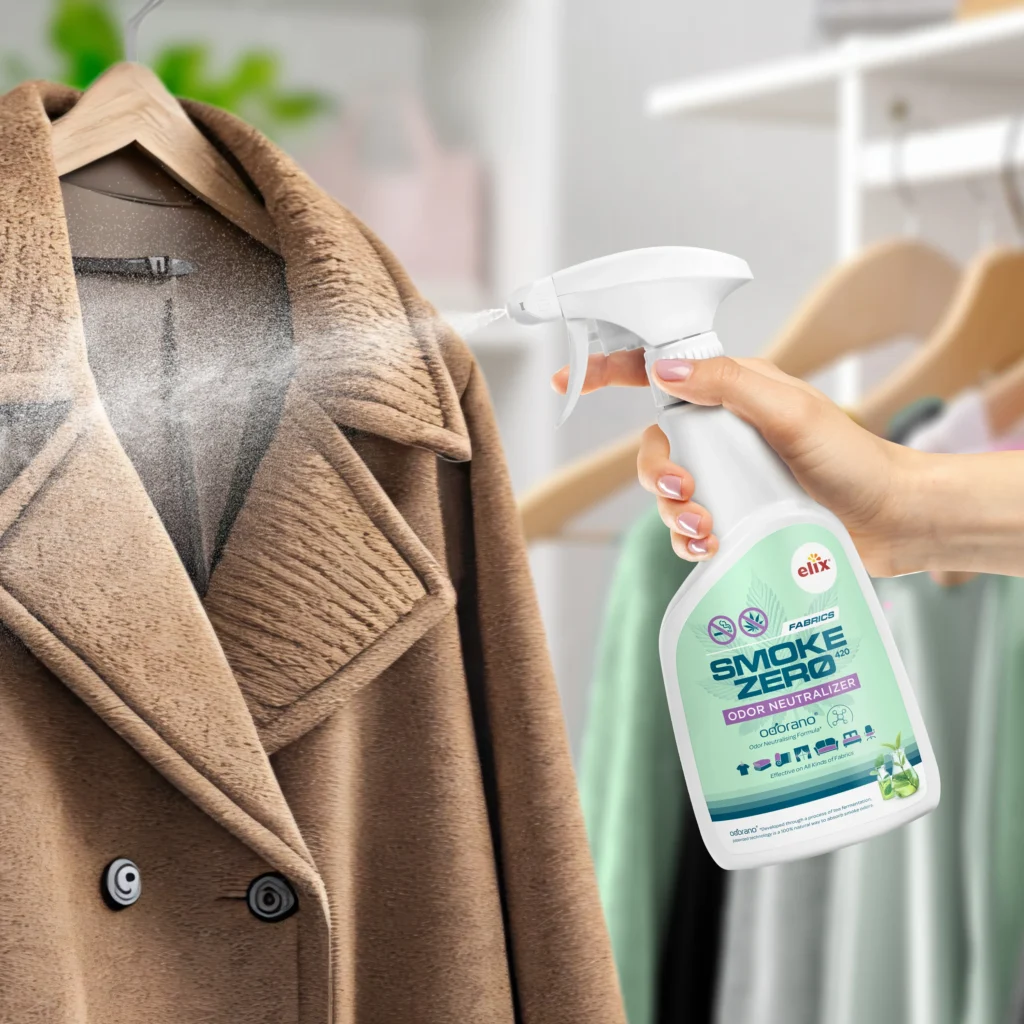
Curtains, carpets, sofas, car seats, mattresses, and clothing hold the largest concentration of smoke odor molecules. These must be treated with a molecular odor neutralizer — a formula that penetrates textile fibers and chemically deactivates embedded VOCs. Unscented formulations work best here: you're eliminating the odor, not replacing it with another smell. Apply, allow 10–15 minutes dwell time, then ventilate.
-
Layer 2 — Clear the air: airborne molecules
After treating fabrics, spray a molecular odor neutralizer into the air of the affected space. This addresses suspended VOCs that haven't yet settled onto surfaces, as well as residual molecules being re-released from treated textiles during the drying process. Five to eight sprays into the center of a standard room are sufficient for most situations.
-
Layer 3 — Maintain: continuous ambient protection
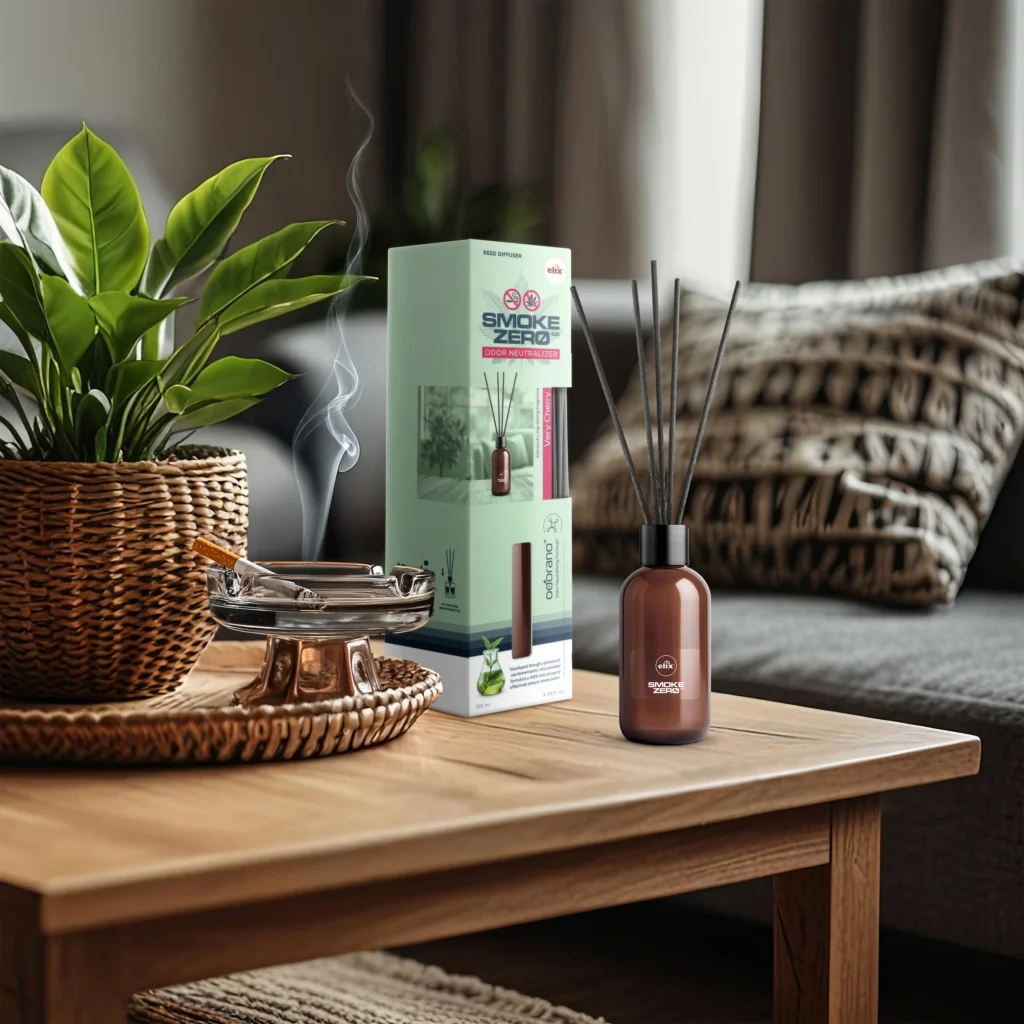
In spaces where smoking occurs regularly — or where a previous occupant smoked for years — a single treatment isn't enough. Passive formats like reed diffusers with active odor neutralizers (not fragrance diffusers) provide continuous low-level molecular protection, intercepting VOC molecules as they're released from surfaces before they become detectable. This is the layer most people skip — and the reason smoke smell keeps coming back.
SMOKE ZERO 420 FABRICS Spray — treat the source first
Unscented molecular neutralizer formulated for all fabric types. Delivers odorano® directly into textile fibers to deactivate embedded smoke VOCs at the source.
View product →Why Molecular Neutralization Is Different
Most odor elimination products work through one of three mechanisms: masking (adding a stronger smell), adsorption (trapping molecules in a porous material like charcoal), or enzymatic breakdown (using bacteria to digest organic compounds). All three have limitations when applied to smoke odors specifically.
The most effective approach — and the one that produces lasting results without harsh chemicals — is molecular adsorption through natural active compounds. The active ingredient in SMOKE ZERO 420, odorano®, is derived through a controlled tea fermentation process. Its active compounds bind directly to VOC odor molecules — including the sulfurous terpenes in cannabis smoke and the phenolic residues from tobacco — and permanently deactivate them through chemical bonding. The result is not a suppressed smell, but a neutralized one: the molecule is changed, not hidden.
Unlike ozone treatments (which require evacuating spaces and carry health risks) or cyclodextrin sprays (which provide only temporary suppression), odorano® works safely in occupied spaces, leaves no chemical residue, and is REACH and CLP compliant.
Method Comparison at a Glance
| Method | Removes air odors | Removes fabric odors | Permanent | Safe in occupied space |
|---|---|---|---|---|
| Air freshener / candle | ✗ masks | ✗ | ✗ | ✓ |
| Baking soda / vinegar | ~ slow | ~ surface only | ✗ | ✓ |
| HEPA air purifier | ✓ | ✗ | ~ ongoing | ✓ |
| Steam cleaning | ✗ | ~ partial | ~ partial | ✓ |
| Ozone generator | ✓ | ✓ | ✓ | ✗ toxic |
| SMOKE ZERO 420 system | ✓ | ✓ | ✓ | ✓ |
Smoke Smell in Specific Situations
Cigarette smell in a car
Car interiors are particularly problematic because the small enclosed volume means smoke VOC concentration is extremely high, and every surface — headliner, seats, carpets, dashboard foam — absorbs odor simultaneously. Standard car air fresheners are entirely inadequate here. For cars, the correct approach is: fabric spray on all upholstered surfaces, a pocket-size air spray for immediate treatment, and a hanging paper freshener for ongoing maintenance. For very heavily saturated interiors, two treatments 24 hours apart deliver complete results.
Smoke smell in a rented apartment or Airbnb
The challenge with rental properties is that smoke may have been accumulating in fabrics and walls for months or years. A single treatment will reduce the odor significantly but may not eliminate it entirely. The most practical approach: treat all soft furnishings with a fabric spray, run an air spray throughout the space, then install a reed diffuser for continuous protection. Repeat the fabric and air treatment after 48 hours for persistent cases. For walls and ceilings with heavy tar buildup, repainting with an odor-sealing primer is the only permanent solution.
Cannabis smell in a home
Cannabis odor is chemically distinct from tobacco smoke and requires a neutralizer specifically effective against sulfurous VOCs. Standard tobacco-focused products may perform poorly against the prenylthiol compounds responsible for the characteristic cannabis smell. Look for products explicitly formulated for both tobacco and cannabis — and verify the active mechanism (molecular neutralization, not fragrance masking).
Smoke smell after a party or single event
Fresh smoke is significantly easier to address than long-term accumulated odor. Ventilate immediately — open windows and use fans to create cross-ventilation. Follow with an air spray and fabric treatment on any soft surfaces where people were smoking near. A single treatment cycle is typically sufficient for fresh exposure.
SMOKE ZERO 420 — Complete system for all situations
Four formats covering every scenario: FABRICS Spray, AIR Spray (500 ml & 75 ml), Reed Diffuser, and Paper Air Freshener — all powered by patented odorano® technology.
View complete system →Key Takeaways
- Smoke odor molecules embed in fabrics and surfaces — treating only the air provides temporary relief at best.
- Popular home remedies (vinegar, baking soda, scented candles) do not destroy smoke VOCs — they mask or mildly absorb them.
- The only permanent solution is molecular neutralization — chemically deactivating odor compounds at the source.
- Effective treatment requires addressing three layers simultaneously: fabrics, air, and continuous ambient protection.
- Cannabis odors (sulfurous terpenes) behave differently to tobacco smoke and require a neutralizer formulated for both.
- Ozone generators work but cannot be used safely in occupied spaces — they are a last resort, not a routine solution.
- For rental properties and cars with heavy odor buildup, repeat treatment after 48 hours for complete results.
How long does it take to get rid of cigarette smell in a room?
For fresh smoke exposure, a full treatment cycle — fabric spray plus air spray — takes 20–30 minutes, with the space fully odor-free within a few hours. For rooms where smoking has occurred regularly over months or years, two treatment cycles 48 hours apart are typically required. Rooms with heavy nicotine buildup on walls may require repainting with an odor-sealing primer for complete permanent results.
Does baking soda actually get rid of smoke smell?
Baking soda provides mild, slow adsorption of some airborne odor compounds through its alkaline chemistry. For very mild, fresh odors it can help reduce smell over time. However, it has no meaningful effect on VOC molecules already embedded deep in carpet fibers or upholstery foam, and does not work at the speed or scale required for cigarette or cannabis smoke odor. It is not an effective standalone solution for smoke odor elimination.
Why does smoke smell keep coming back even after cleaning?
Smoke odor returns because the odor molecules are still present in fabrics, carpets, and porous surfaces — continuously re-releasing into the air. Cleaning surfaces and ventilating the room addresses the air but leaves the embedded odor source untouched. The smell "comes back" because it never fully left — it was just diluted temporarily. Permanent elimination requires treating the fabric layer with a molecular neutralizer, not just cleaning hard surfaces or freshening the air.
What is the fastest way to get rid of smoke smell before guests arrive?
The fastest effective approach: open windows immediately for cross-ventilation, apply an odor-neutralizing fabric spray to curtains, upholstery, and carpets (allow 10 minutes), then spray an active air spray throughout the room. This combination treats both layers simultaneously and delivers noticeable results within 30–45 minutes. Avoid fragrance-heavy masking sprays — they create an unpleasant layered smell when mixed with smoke odor.
Is cannabis smell harder to remove than cigarette smoke?
Yes, in many respects. Cannabis smoke contains prenylthiol — a volatile sulfur compound — which is detectable by humans at extremely low concentrations and is highly adhesive to textiles. Standard tobacco odor eliminators may perform poorly against cannabis odors because they are not formulated for sulfurous compounds specifically. Products explicitly designed for both tobacco and cannabis smoke, using molecular neutralization rather than fragrance masking, are required for reliable results.
Can an air purifier fully remove cigarette smell?
A quality air purifier with both HEPA filtration (for particles) and an activated carbon layer (for VOCs) is effective at removing airborne smoke odors. However, it cannot eliminate odors already absorbed into carpets, upholstery, or curtains — which is the primary source of persistent smoke smell in most rooms. Air purifiers work best as part of a complete system, not as a standalone solution. Expect to pay €150–€500+ for a unit with sufficient carbon capacity for smoke odor.
How do I permanently remove smoke smell from a car?
For a car with significant cigarette or cannabis odor: first vacuum all surfaces thoroughly, then apply a fabric odor neutralizer spray to seats, carpets, headliner, and boot area — allow 10–15 minutes dwell time. Follow with an air spray (a 75 ml pocket format works well for car interiors). For ongoing protection, a hanging paper freshener with molecular odor-neutralizing formula maintains results between treatments. For very heavily saturated vehicles, repeat the full treatment after 48 hours.